
Making the Most of Social Security
How Your Benefit Is Calculated
Many people know that Social Security pays a monthly retirement benefit. Fewer understand how that number is actually determined, or how much the timing of their claim can change it.
Your benefit is rooted in your Primary Insurance Amount, commonly referred to as your PIA. This is the monthly payment you are entitled to if you begin collecting at your Full Retirement Age, or FRA. The Social Security Administration calculates your PIA using your highest 35 years of indexed earnings. If you worked fewer than 35 years, zeroes are averaged in for the missing years, which can meaningfully reduce your benefit.[14]
Full Retirement Age
Full retirement age is not the same for everyone. For anyone born in 1960 or later, FRA is 67. For those born between 1955 and 1959, FRA phases in between 66 and 67. You can confirm your specific FRA at ssa.gov.[1]
1943 through 1954: 66
1955: 66 and 2 months
1956: 66 and 4 months
1957: 66 and 6 months
1958: 66 and 8 months
1959: 66 and 10 months
1960 and later: 67
Filing Early: The Permanent Reduction
You can begin collecting as early as age 62. Doing so permanently reduces your monthly benefit. The reduction is calculated per month you file before your FRA. For someone with an FRA of 67 who files at 62 (60 months early), the reduction works as follows:
The first 36 months early: benefit is reduced by 5/9 of 1% per month (approximately 20% total)
The next 24 months: benefit is reduced by 5/12 of 1% per month (approximately 10% total)
The result: filing at 62 with an FRA of 67 produces a permanent 30% reduction in your monthly benefit. On a $2,000 PIA, that means $1,400 per month instead of $2,000, for as long as you live.[3]
Filing Late: Delayed Retirement Credits
For every month you delay beyond your FRA, your benefit increases. For anyone born in 1943 or later, that increase is 8% per year, or two-thirds of 1% per month. This growth stops at age 70. Waiting from 67 to 70 increases your benefit by 24%. On a $2,000 PIA, that is $2,480 per month.[2]
Common Questions
When is the earliest I can file?
Age 62. However, you must be at least 62 for the entire month, and your benefit will be permanently reduced from the amount you would receive at your FRA.[3]
Can I work while collecting Social Security?
Yes, but with limitations if you are below your FRA. In 2025, the earnings limit is $23,400 per year. If you exceed that, the Social Security Administration withholds $1 in benefits for every $2 of earnings above the limit. In the year you reach FRA, the limit rises to $62,160, and only $1 is withheld per $3 above the limit. Once you reach FRA, there is no earnings limit. Benefits withheld before FRA are not lost permanently. SSA recalculates your benefit upward at FRA to account for those withheld months.[15]
Does my benefit keep growing if I wait past 70?
No. Delayed retirement credits stop accruing at age 70. There is no financial benefit to waiting beyond that point.[2]
Will Social Security be enough to live on?
For many retirees, Social Security is intended to provide only a portion of retirement income. Social Security was designed to replace approximately 40% of pre-retirement income for an average earner. It is one income source among many, not a complete retirement plan.[17]
Can I change my mind after I file?
Within the first 12 months of filing, you can withdraw your application, repay all benefits received, and re-file later as if you never claimed. After 12 months, you can voluntarily suspend benefits at FRA or older to earn delayed credits going forward. However, suspending your benefits also suspends any spousal benefits being paid on your record.[4]
The Breakeven Question: Filing Early and Investing vs. Deferring
One of the most common arguments for filing early is the opportunity to invest those benefits rather than delay them. The logic: if you can earn a meaningful return on early benefits, you may come out ahead even with a reduced monthly payment. The question is when, if ever, the deferred strategy overtakes the early-filing strategy.
The chart below illustrates this comparison. The scenarios assume a $4,000 monthly benefit at FRA (age 67) and a 5% annual investment return on all benefits received, compounding monthly. Filing at 62 produces a permanently reduced benefit of $2,800 per month. Filing at 70 produces $4,960.[5]
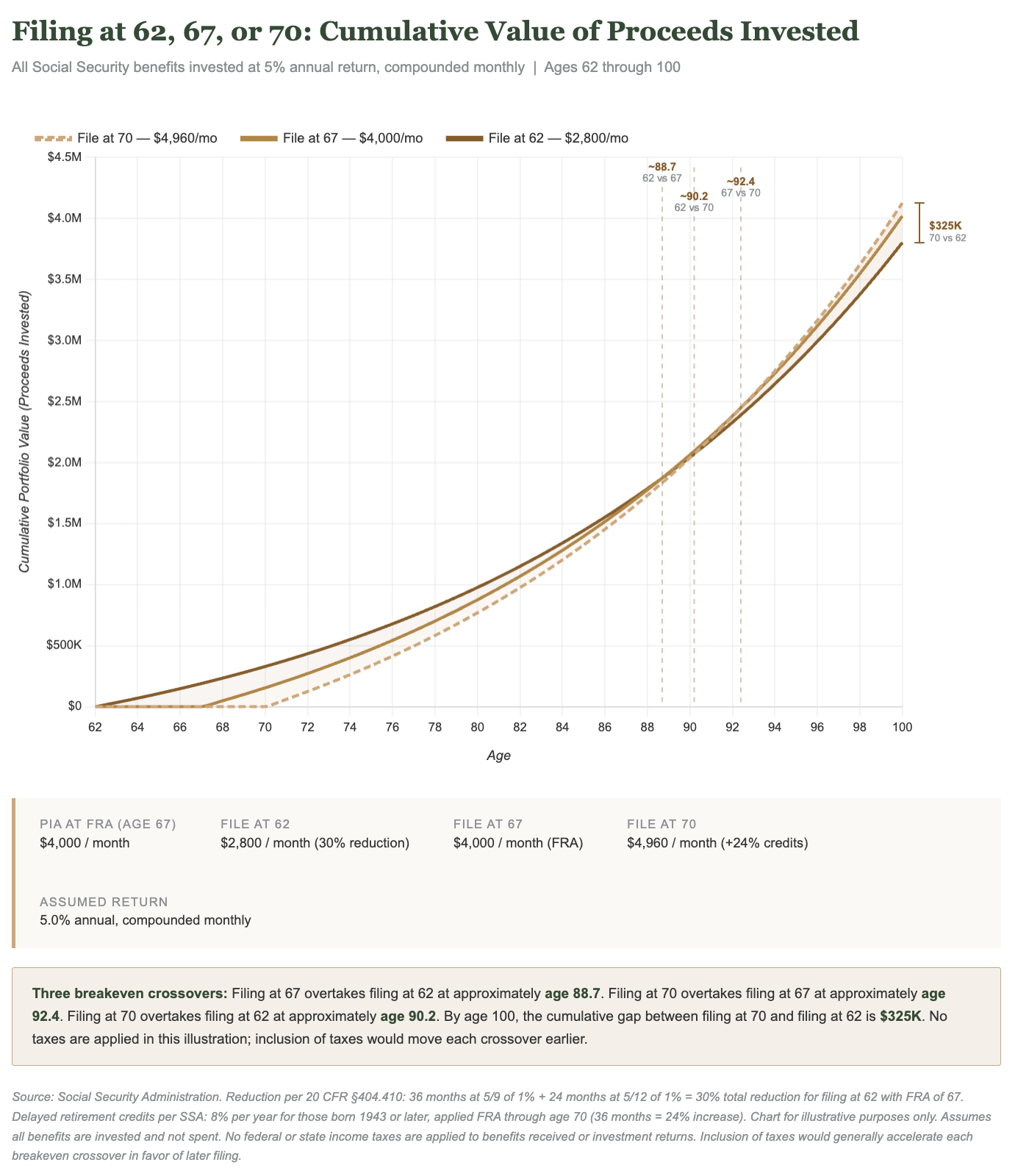
The math is counterintuitive for many people. Filing early means five additional years of payments coming in, which accumulate and grow. But the lower monthly amount means a slower rate of accumulation once both claimants are receiving benefits. Based on a 5% return assumption, the two strategies reach approximate parity in the late 80s to early 90s.
A few points worth understanding about this analysis:
The 5% return assumption is not guaranteed. A lower actual return accelerates the breakeven in favor of deferral. A higher return extends the advantage of filing early.
This comparison assumes all benefits are invested, which is rarely the case in practice. Most retirees spend some or all of their Social Security income. The breakeven shifts considerably when benefits are spent rather than invested.
Taxes are not reflected in this analysis. Social Security benefits may be partially taxable depending on total income, and investment returns are subject to capital gains tax. Deferral strategies often become more compelling once taxes are incorporated.
Survivor considerations are not captured here. A higher benefit at death translates to a higher survivor benefit for a spouse, which can add decades of additional value.[12]
The breakeven analysis is a useful reference point, not a decision rule. The right filing age depends on your health, your other income sources, your spouse's situation, and how Social Security fits into the broader tax and withdrawal strategy.
Spousal Benefit Strategies
For married couples, Social Security is not a single filing decision. It is two decisions that interact with each other in ways that significantly affect lifetime household income.
How Spousal Benefits Work
A spouse who did not work, or whose own benefit is smaller than the spousal benefit, may be entitled to a benefit based on the other spouse's record. The maximum spousal benefit is 50% of the higher earner's Primary Insurance Amount at their FRA. This cap is based on the higher earner's PIA regardless of whether they delayed to 70 and earned a higher benefit.[6][7]
To receive any spousal benefit, the higher-earning spouse must have already filed for their own retirement benefit.[4]
The Deemed Filing Rule
A critical rule governs spousal filing: deemed filing. For anyone born on or after January 2, 1954, filing for any Social Security benefit is treated as filing for all benefits simultaneously. You cannot claim just a spousal benefit and delay your own, or vice versa. When you file, SSA determines which benefit, your own or the spousal amount, is higher and pays accordingly.[4]
Early Filing and the Spousal Reduction
If the lower-earning spouse files for benefits before their own FRA, their spousal benefit is permanently reduced. The reduction formula for spousal benefits is slightly different from the own-record reduction:
First 36 months before FRA: approximately 25/36 of 1% per month
Beyond 36 months: approximately 5/12 of 1% per month
Filing the maximum 5 years early (age 62 with FRA of 67) produces approximately a 35% reduction in the spousal benefit. A $1,000 maximum spousal benefit becomes approximately $650.[3]
Unlike the own-record benefit, there is no advantage to delaying a spousal benefit claim past FRA. It does not continue to grow.[6]
The Primary Earner's Filing Is the Controlling Decision
In practice, the higher earner's filing age drives most of the household's lifetime Social Security outcome. Their decision determines:
When the spousal benefit becomes available at all
The dollar amount the spousal benefit is calculated from (50% of their PIA)
The survivor benefit the other spouse would receive if the higher earner dies first
This is why, for couples with a significant earnings disparity, a common strategy is for the higher earner to delay to 70, maximizing both their own benefit and the survivor benefit, while the lower earner files at a time that makes sense for their own circumstances.[6][12]
The Age-Gap Scenario
When there is a significant age difference between spouses, timing becomes even more important. Consider a couple where the primary earner is 67 and the younger spouse is 50. The primary earner can file at FRA today, locking in their benefit and beginning to collect. The younger spouse cannot begin collecting spousal benefits until they reach age 62, twelve years from now. At that point, they can file for their reduced spousal benefit, or wait until their own FRA to receive the full 50%.[4][6][7]
Social Security and Your Distribution Plan
Social Security is not an island. The timing of your claim interacts directly with your tax liability, your withdrawal sequencing, and the long-term durability of your retirement portfolio. Considering Social Security alongside other retirement decisions may provide a more complete planning perspective.
The Tax Interaction
The year you begin Social Security, you add a new income source to your tax picture. Depending on your total income, up to 85% of your benefit may be federally taxable. For retirees drawing from tax-deferred accounts like traditional IRAs or 401(k)s simultaneously, this can push income into a higher bracket than anticipated.[9][10]
Delaying Social Security while spending from pre-tax accounts in the early years of retirement is one approach. It reduces the pre-tax account balance, which lowers future Required Minimum Distributions, and allows the Social Security benefit to grow. When benefits ultimately begin, the combination of a larger Social Security check and a smaller RMD may result in a lower overall tax burden.[16]
Roth Conversions in the Window Before Filing
The period between retirement and the start of Social Security may present an opportunity to consider Roth conversions. With earned income reduced or eliminated and Social Security not yet in payment, taxable income may be at its lowest point in decades. Converting pre-tax assets to Roth during this window can reduce future RMDs, lower lifetime taxes, and create tax-free assets for both spending and legacy purposes.
Adding Social Security income mid-conversion strategy changes the math. Earlier filing compresses or eliminates this window.
Required Minimum Distributions
For anyone with significant pre-tax retirement account balances, RMDs beginning at age 73 can force large taxable distributions regardless of spending need. A larger Social Security benefit paired with heavy RMDs is a common driver of unexpectedly high tax bills in later retirement.[16]
Coordinating the start of Social Security with a longer-term RMD reduction strategy, whether through Roth conversions, QCDs, or deliberate pre-RMD drawdown, is one of the more valuable planning conversations available to pre-retirees.
Withdrawal Sequencing
The order in which you draw from different account types, taxable, tax-deferred, and tax-free, matters significantly for after-tax outcomes. Social Security timing is a key variable in that sequencing. A higher monthly income from a larger delayed benefit may allow you to take less from your portfolio in down markets, reducing sequence of returns risk while leaving tax-advantaged accounts more time to grow.
How Social Security Is Taxed
Many retirees are surprised to learn that Social Security benefits are subject to federal income tax. Whether your benefits are taxable, and to what extent, depends on a calculation called provisional income.
Provisional Income: The Formula
Provisional income is defined by the IRS as:
Your adjusted gross income (AGI)
Plus tax-exempt interest income (such as municipal bond interest)
Plus 50% of your Social Security benefits
That total determines what percentage of your benefits may be included in taxable income.[9]
Single / Head of Household:
Below $25,000 — none of your benefits taxable
$25,000 to $34,000 — up to 50% taxable
Above $34,000 — up to 85% taxable
Married Filing Jointly:
Below $32,000 — none of your benefits taxable
$32,000 to $44,000 — up to 50% taxable
Above $44,000 — up to 85% taxable
Note that these thresholds have not been adjusted for inflation since they were set in 1983 and 1993. As a result, the majority of Social Security recipients today have at least some portion of their benefits taxed. The maximum taxable portion is 85% of your benefit. No more than 85% can be included in gross income under any circumstances.[9][10]
Common Planning Levers
Because provisional income includes tax-exempt interest and 50% of benefits, strategies that reduce other income can reduce the taxable portion of Social Security:
Qualified Charitable Distributions from IRAs reduce adjusted gross income dollar for dollar, which lowers provisional income without reducing your giving
Drawing from Roth accounts rather than traditional accounts produces income that does not count toward provisional income
Capital loss harvesting can reduce AGI in years where it is otherwise elevated
Social Security benefits are not subject to FICA payroll taxes. They are reported on Form SSA-1099, which you receive each January, and the taxable portion is reported on line 6b of Form 1040.[8][9][10]
Survivor Benefits: When a Spouse Passes
The death of a spouse triggers a significant change to the household's Social Security picture. Understanding how survivor benefits work, and how they differ from spousal benefits, is an important part of planning for the long term.
The Step-Up to the Higher Benefit
When one spouse dies, the surviving spouse is entitled to the higher of their own retirement benefit or the deceased spouse's benefit. This is a meaningful distinction from the spousal benefit, which is capped at 50% of the higher earner's PIA. The survivor benefit can be as much as 100% of what the deceased was receiving or entitled to receive.[12]
Survivor Benefit Amounts by Filing Age
At own Full Retirement Age or older: 100% of deceased worker's benefit amount
Age 60 through Full Retirement Age: 71.5% to 99% of deceased worker's benefit
Age 50 through 59 (if disabled): 71.5%
Any age (caring for child under 16): 75%
A surviving spouse can begin receiving reduced survivor benefits as early as age 60. The longer they wait, up to their FRA for survivor purposes, the higher the monthly amount.[12]
Why the Higher Earner's Filing Age Matters So Much
Because the survivor receives 100% of the deceased's benefit, the amount the higher earner was collecting at death directly determines what the surviving spouse lives on for the rest of their life. A higher earner who delays to 70 and earns a 24% increase over their FRA benefit is passing that larger amount to the surviving spouse permanently.[2][12]
This is one of the most compelling arguments for the higher earner to delay, even when it feels uncomfortable to defer income. The value of that delayed benefit is not just personal. It may provide a larger continuing survivor benefit for the person most likely to outlive the other.
Survivor Benefits vs. Own Retirement Benefit
A surviving spouse does not have to choose their claiming strategy all at once. They may be able to start one benefit at a reduced rate and allow the other to grow. For example, a surviving spouse could begin collecting survivor benefits early, allowing their own retirement benefit to continue accruing delayed credits until age 70. Or they could take their own reduced retirement benefit while waiting to claim a higher survivor benefit at FRA. The appropriate approach depends on the relative size of the two benefits and the survivor's age and health.
The Social Security application for survivor benefits is not available online. It must be completed by phone or in person at a local Social Security office.[11]
Eligibility Requirements
Must be at least age 60 (or 50 with a qualifying disability)
Must have been married for at least 9 months prior to the worker's death
Must not have remarried before age 60 (age 50 if disabled)
Divorced spouses may also be eligible if the marriage lasted at least 10 years
A one-time lump-sum death payment of $255 may also be available to the surviving spouse or eligible children, subject to certain requirements.[11][12][13]
Ready to Talk Through Your Social Security Strategy?
Social Security timing is one of the most consequential decisions in retirement planning, and it rarely makes sense to approach it in isolation. If you are within ten years of your target retirement date, it is worth having this conversation early. The right claiming age depends on your health, your income sources, your spouse's situation, and how Social Security fits into your broader tax and withdrawal plan. We are happy to walk through your specifics together.
Sources
Social Security Administration. "Retirement Age Calculator." ssa.gov/benefits/retirement/planner/ageincrease.html
Social Security Administration. "Delayed Retirement Credits." ssa.gov/benefits/retirement/planner/delayret.html
Code of Federal Regulations. 20 CFR Section 404.410. ssa.gov/OP_Home/cfr20/404/404-0410.htm
Social Security Administration. "Filing Rules for Retirement and Spouses Benefits." ssa.gov/benefits/retirement/planner/claiming.html
Social Security Administration. "Benefits By Year Of Birth / Retirement Age Chart." ssa.gov/benefits/retirement/planner/agereduction.html
Social Security Administration. "Family Benefits." ssa.gov/family
Social Security Administration. "Do You Qualify for Social Security Spouse's Benefits?" ssa.gov/blog/en/posts/2024-07-11.html
Internal Revenue Service. "Social Security Income." irs.gov/faqs/social-security-income
Internal Revenue Service. "Publication 915: Social Security and Equivalent Railroad Retirement Benefits." irs.gov/publications/p915
Internal Revenue Service. "IRS Reminds Taxpayers Their Social Security Benefits May Be Taxable." irs.gov/newsroom/irs-reminds-taxpayers-their-social-security-benefits-may-be-taxable
Social Security Administration. "If You Are The Survivor." ssa.gov/benefits/survivors/ifyou.html
Social Security Administration. "What You Could Get From Survivor Benefits." ssa.gov/survivor/amount
Social Security Administration. "Who Can Get Survivor Benefits." ssa.gov/survivor/eligibility
Social Security Administration. "Your Retirement Benefit: How It's Determined." (Publication No. 05-10070) ssa.gov/pubs/EN-05-10070.pdf
Social Security Administration. "Receiving Benefits While Working." ssa.gov/benefits/retirement/planner/whileworking.html
Internal Revenue Service. "Retirement Topics — Required Minimum Distributions (RMDs)." irs.gov/retirement-plans/plan-participant-employee/retirement-topics-required-minimum-distributions-rmds
Social Security Administration. "Retirement Ready Fact Sheet for Workers Ages 18-48." ssa.gov/myaccount/assets/materials/workers-18-48.pdf
Disclosure
This article is provided by McAdam LLC ("McAdam" or the "Firm") for informational purposes only. Investing involves the risk of loss, and investors should be prepared to bear potential losses. Past performance may not be indicative of future results and may have been impacted by events and economic conditions that will not prevail in the future. No portion of this article is to be construed as a solicitation to buy or sell a security or the provision of personalized investment, tax, or legal advice. Certain information contained in this report is derived from sources that McAdam believes to be reliable; however, the Firm does not guarantee the accuracy or timeliness of such information and assumes no liability for any resulting damages.
Securities offered only by duly registered individuals through Madison Avenue Securities, LLC (MAS), member FINRA/SIPC. Investment advisory services offered only by duly registered individuals of McAdam, LLC, a registered investment advisor. Insurance products and services offered through McAdam Financial. Donohue Wealth Management DBA McAdam, LLC and McAdam Financial are not affiliated with MAS.
Donohue Wealth Management is a registered investment adviser. Registration does not imply a certain level of skill or training.
Chart data sourced from Social Security Administration and Internal Revenue Service publications. For illustrative purposes only. Breakeven chart assumes a $4,000/month PIA at FRA (age 67), a 30% benefit reduction for filing at age 62, and a 5% annual investment return compounded monthly on all benefits received. Actual results will vary.