
Net Unrealized Appreciation: A Potentially Overlooked Tax Strategy for Company Stock
If you hold highly appreciated employer stock in your 401(k), rolling it all into an IRA at retirement may not be the most tax-efficient move.
What Is Net Unrealized Appreciation?
Net unrealized appreciation, or NUA, refers to the increase in value of employer stock held inside a qualified retirement plan, such as a 401(k) or profit-sharing plan, from the time the plan acquired the shares to the date of distribution.
Under IRS rules (IRC Section 402(e)(4)), when employer stock is distributed in-kind as part of a qualifying lump-sum distribution, the NUA portion is not taxed as ordinary income at distribution. Instead, it is taxed at long-term capital gains rates when the shares are eventually sold, regardless of how long the stock was held inside the plan.
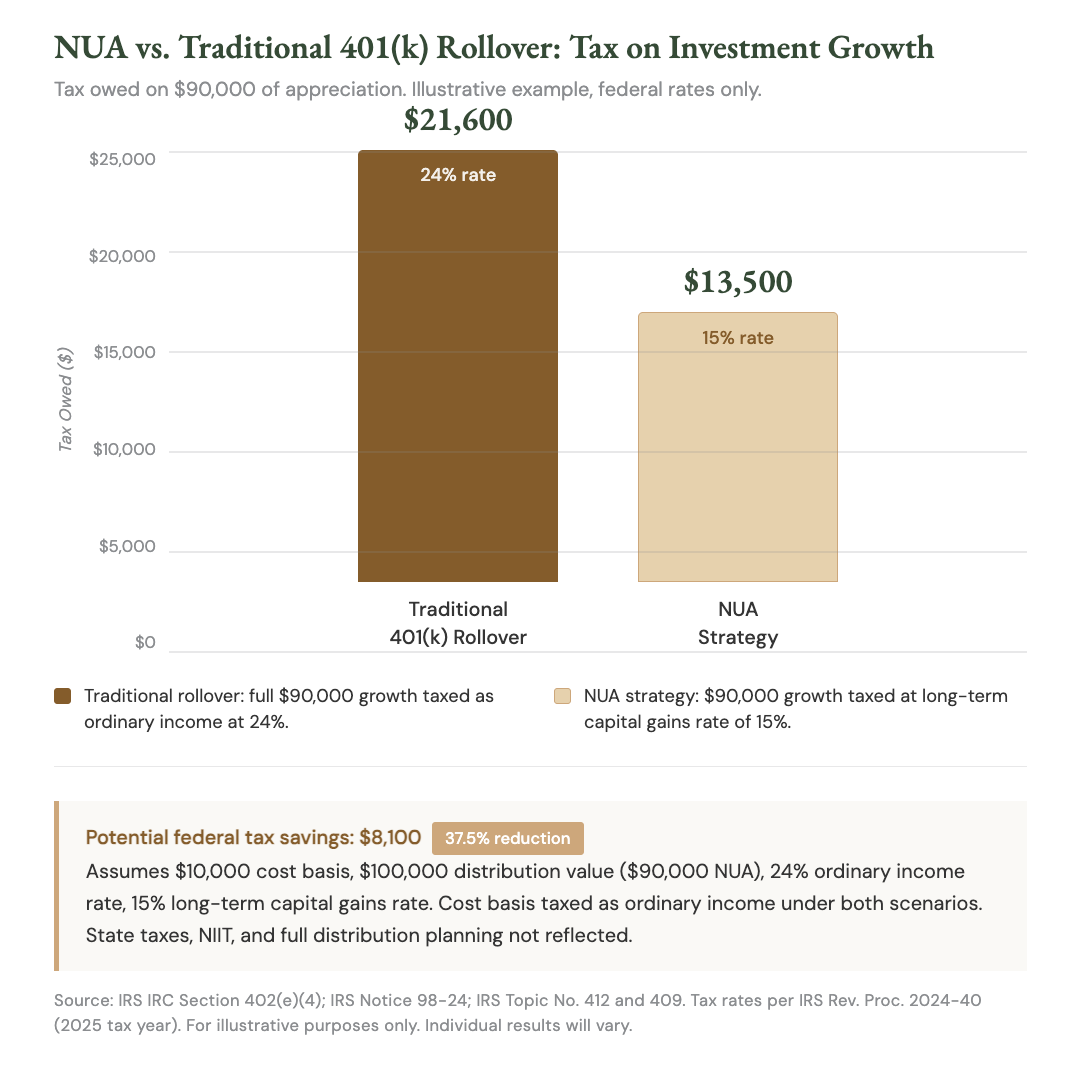
That distinction matters because ordinary income tax rates currently range from 10% to 37%, while long-term capital gains rates for most people fall at 15% (depending on individual circumstances and current tax law). For someone in a higher income bracket, that gap can translate into a meaningful and permanent reduction in taxes owed on the appreciated portion of their account.
When Does the Strategy Become Available?
The NUA rules are not available at will. A triggering event is required before a qualifying lump-sum distribution can be taken. The IRS recognizes four: separation from service (retiring, quitting, or being terminated), reaching age 59 and a half, death, or disability.
Once a triggering event occurs, the timing is flexible. The plan participant does not need to act immediately, and it is possible to wait for a more advantageous tax year.
One important caution: taking a partial distribution from the plan after a triggering event can disqualify the NUA strategy. If that happens, eligibility may potentially be reestablished if another triggering event occurs later.
How It Works
The mechanics are straightforward, though the execution requires care.
When an individual takes a lump-sum distribution of employer stock from a qualified plan, the IRS applies a bifurcated tax treatment: the cost basis of the stock is taxed immediately at ordinary income rates, while the appreciation above that basis, the NUA, defers taxation until the shares are sold in the taxable account. When sold, the NUA is taxed at long-term capital gains rates, even if the stock is sold shortly after distribution.
Any additional appreciation that occurs after the distribution date is taxed at short- or long-term capital gains rates depending on how long those shares are held going forward.
There is also flexibility in how the distribution is structured. While the lump-sum distribution requirement means the entire account balance must be distributed in a single tax year, not all of it needs to be a taxable event. It is permissible to take the employer stock as an in-kind distribution while rolling the remaining plan assets over to an IRA.
The Potential Benefit
The advantage of the NUA strategy is most pronounced when three conditions align: the employer stock is highly appreciated relative to its original cost basis, the account holder is in a meaningful income tax bracket, and long-term capital gains rates are materially lower than ordinary income rates.
For eligible participants, the result can be a significant reduction in lifetime taxes owed on that growth, taxes that would otherwise be unavoidable under a traditional rollover approach.
The Trade-Offs
The NUA strategy is not the right answer in every situation, and several factors can reduce or eliminate its advantage.
Ordinary income on the cost basis. The cost basis of the distributed shares is taxed as ordinary income in the year of distribution, regardless of how small or large that amount may be. In years where other income is already elevated, the timing of this tax hit matters.
Loss of tax-deferred growth. Unlike rolling assets into an IRA, distributing employer stock via NUA places those shares into a taxable account, ending the benefit of tax-deferred growth from that point forward. Future dividends and gains will be taxable annually.
Concentration risk. The strategy is predicated on holding a single company's stock, often in a meaningful amount. That concentration carries real investment risk that must be weighed independently of the tax benefit.
Low cost basis reduces the advantage. If the cost basis is relatively high compared to the current value, the NUA portion is smaller, and the tax benefit narrows accordingly. The strategy works best when the stock has appreciated substantially.
State taxes and other considerations. Federal rates are only part of the picture. State income and capital gains taxes should be factored into any analysis, as they vary meaningfully by state and can narrow the advantage. It is also worth noting that the NUA gain itself is excluded from the 3.8% net investment income tax; however, any appreciation that occurs after the distribution date is considered net investment income and may be subject to NIIT for earners above the applicable MAGI thresholds.
Is This Worth Exploring for You?
If you hold employer stock inside a 401(k) or similar plan and are approaching or have already reached a triggering event, it is worth examining whether the NUA rules could reduce your lifetime tax burden on that growth.
The analysis is straightforward in concept but requires accurate data: the current fair market value of the shares, the plan's reported cost basis, your expected income in the year of distribution, and your projected long-term tax situation. Getting those inputs right, and stress-testing the comparison against a traditional rollover, is how you determine whether the strategy makes sense for your specific situation.
Ready to explore whether NUA applies to your plan? Schedule a conversation with our team to walk through the numbers for your specific situation.
Sources
Internal Revenue Code Section 402(e)(4). U.S. Code. https://uscode.house.gov
IRS Notice 98-24. Net Unrealized Appreciation in Employer Securities. Internal Revenue Service. 1998.
IRS Topic No. 412, Lump-Sum Distributions. Internal Revenue Service. https://www.irs.gov/taxtopics/tc412
IRS Topic No. 409, Capital Gains and Losses. Internal Revenue Service. https://www.irs.gov/taxtopics/tc409
IRS Rev. Proc. 2024-40. 2025 Tax Year Inflation Adjustments. Internal Revenue Service.
Note: Tax rates and thresholds are subject to change. Verify current-year figures at IRS.gov before acting.
Disclosure
This article is provided by McAdam LLC ("McAdam" or the "Firm") for informational purposes only. Investing involves the risk of loss, and investors should be prepared to bear potential losses. Past performance may not be indicative of future results and may have been impacted by events and economic conditions that will not prevail in the future. No portion of this article is to be construed as a solicitation to buy or sell a security or the provision of personalized investment, tax, or legal advice. Certain information contained in this report is derived from sources that McAdam believes to be reliable; however, the Firm does not guarantee the accuracy or timeliness of such information and assumes no liability for any resulting damages. Donohue Wealth Management is a DBA of McAdam LLC, an SEC registered investment adviser.
Chart data sourced from IRS IRC Section 402(e)(4), IRS Notice 98-24, and IRS Rev. Proc. 2024-40. For illustrative purposes only. Individual results will vary.