
Understanding Structured Products
Most investments leave the outcome open-ended. You put money into a stock, a fund, or a bond, and whatever the market does, you feel it in full. Up years are rewarding. Down years can be painful. Structured products offer a different way of thinking about that relationship.
Rather than simply accepting whatever return the market delivers, these products allow you to define in advance how you want to participate. How much upside do you want access to? How much downside are you willing to absorb? The answers to those questions can be built directly into the investment itself.
This piece is meant to introduce the concept, walk through a few of the ways it shows up in practice, and flag the things worth knowing before you consider one. It is not a recommendation of any specific product, and the examples used throughout are illustrative.
What Is a Structured Product?
At its most basic, a structured product links your return to a market index, like the S&P 500, but changes the rules around how that return is delivered to you.
Instead of owning the index directly, you enter into an agreement that modifies what you receive based on a defined formula. That formula might protect you from losses up to a certain point, amplify your gains beyond what the index alone would deliver, or provide a defined level of principal protection or return based on the product's specific terms. The structure is the mechanism. The index is just the measuring stick.
What makes this category distinct is intentionality. The market still does what the market does. But you are no longer simply along for the ride.
These products are offered through a range of financial institutions, including banks and insurance companies, among others. Where a product comes from matters. It affects how it is regulated, how easily it can be exited, and what it actually costs, which we will come back to later. For products issued by financial institutions, the issuer's financial strength is an important consideration because contractual payments depend on the issuer's ability to meet its obligations.
The Indexed Approach: Participating With Protection
One of the most common ways structured products are used is to stay connected to the market while putting a limit on how much you can lose.
Here is how it works. Depending on the product's structure, you may agree to a floor, most commonly 0%, which means your principal is protected if the index declines, assuming the product is held according to its terms. In exchange, your upside is capped at a set level, say 8% per year. If the market is up 25%, you receive 8%. If the market is down 20%, you receive 0%. The index keeps moving the way it always does. You just experience it differently.
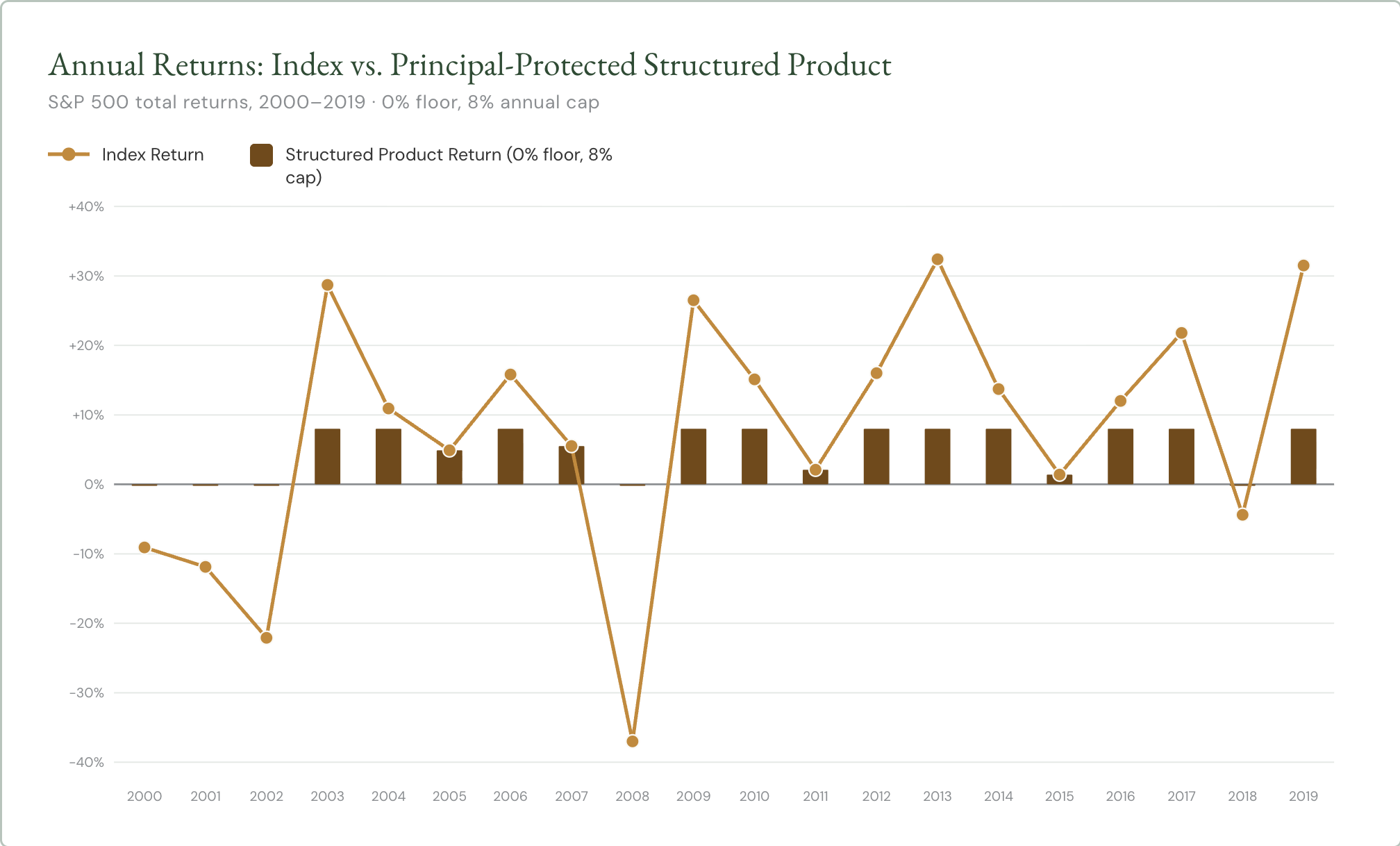
Illustrative hypothetical data. For educational purposes only. Past performance is not indicative of future results.
The chart above covers twenty years of actual S&P 500 returns, spanning two of the worst market environments in modern history: the dot-com bust from 2000 through 2002 and the 2008 financial crisis. In each of those down years, a product with a 0% floor would have preserved your principal entirely while the index was suffering meaningful losses. In the strong recovery years like 2003, 2009, 2013, and 2019, your return would have been capped at 8% regardless of how far the market ran. Over the full twenty-year stretch, those two effects roughly balanced each other out. Actual levels of protection, participation rates, caps, and other features vary by product and issuer. Investors should carefully review the applicable offering documents to understand the terms, risks and limitations of any specific product before investing.
This kind of structure tends to appeal to investors who want to stay in the market but are not comfortable absorbing the full range of outcomes it can produce. That might be someone approaching retirement, someone who has already accumulated significant wealth and is more focused on protecting it, or simply someone who sleeps better knowing there is a floor beneath them.
It is also worth considering how this compares to more traditional conservative allocations. Depending on cap rates, market performance, and the interest rate environment, a principal-protected structured product may outperform fixed income or cash under some market environments while still offering the same fundamental assurance: your principal is not at risk. For investors whose primary reason for holding bonds or cash is to avoid losses, that is a comparison worth exploring.
Accelerated Returns: Trading Liquidity for Enhanced Upside
A different kind of structured product works in the opposite direction. Rather than limiting how much you can lose, it increases how much you can gain, in exchange for giving up access to your money for a defined period of time.
The way this typically works: you agree to hold the investment for a set term, often two to three years, and in exchange you receive an enhanced share of whatever the index returns. Instead of getting 100% of the gain, you might get 120% or more. If the index is up 25% over the period, you receive 30%. If it is up 10%, you receive 12%. The underlying exposure is exactly the same. You are just getting a larger share of the result.
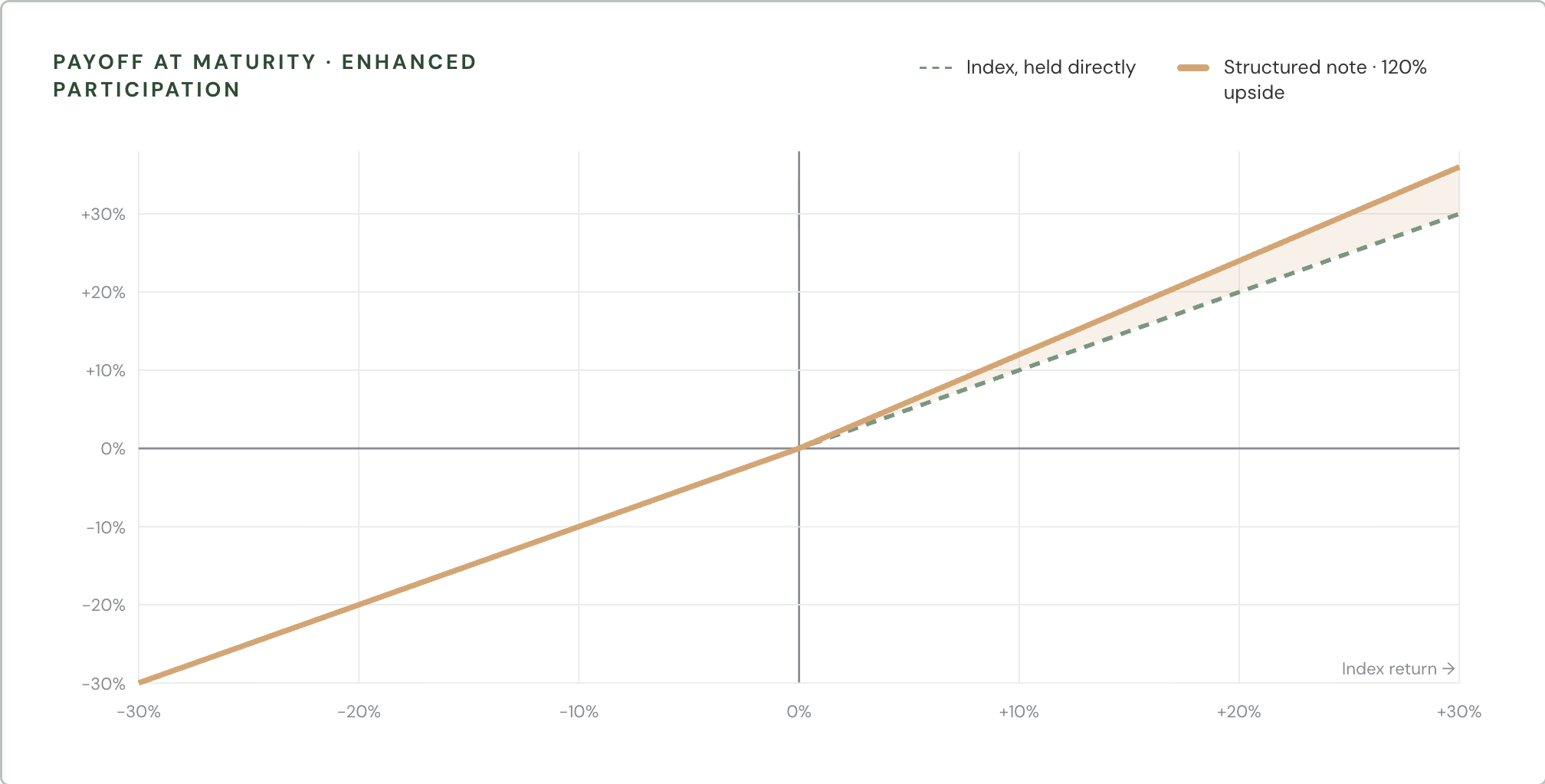
Illustrative hypothetical example only. This chart does not represent the performance or terms of any specific structured product. Participation rates, caps, downside protection, liquidity, and other features vary by product and issuer. Past performance is not indicative of future results.
The trade-off is real, though. There is no floor protection here. If the index is down at the end of the term, you participate in that loss just as you would if you owned the index directly. And your money is committed for the full holding period, which means you need to be comfortable not having access to it in the meantime.
The diagram above shows the payoff profile side by side. To the left of zero, both lines are identical: losses are shared in full. To the right of zero, the note line pulls ahead of the index line and widens as returns grow, reflecting the enhanced participation rate.
For investors who do not have a near-term need for that capital and are comfortable with full market exposure on the downside, this structure offers a straightforward way to get more out of an index position you would have held anyway. The enhanced return is the compensation for locking up your money. Whether that trade-off makes sense depends on your situation.
Other Structures Worth Knowing
The indexed and accelerated approaches are two of the more common starting points, but the category goes well beyond them. A few others worth being aware of:
Buffered structures offer partial rather than full downside protection. Instead of a 0% floor, you might be protected against the first 10% or 20% of losses. If the index falls 15% and your buffer is 10%, you absorb 5%. In exchange for the reduced protection, these products typically offer a higher cap than fully principal-protected designs.
Income-generating structures are built around distributions rather than growth. They may pay out periodic income tied to the performance of an index, subject to defined conditions. These tend to appeal to investors who are looking for yield and are comfortable with the conditions attached to receiving it.
Dual directional structures allow you to benefit from movement in either direction, up to a point. If the index falls 10%, for example, the product might return positive 10% rather than negative 10%, within a defined range. These are less common but can be useful in specific contexts.
Principal-at-risk structures sit at the other end of the spectrum. They offer higher participation rates or other enhanced features but provide no protection of your initial investment. These carry significantly more risk and function more like a leveraged position than a protected one.
Key Considerations Before Investing
Structured products can be useful tools in the right circumstances. They can also be poorly understood, poorly selected, and expensive in ways that are not always obvious. A few things to keep in mind:
They are not simple. Each product has its own formula, conditions, and term. It is important to understand exactly how it behaves across a range of market scenarios, including the bad ones, before committing capital.
The issuer matters. A structured product is ultimately a promise made by a financial institution. Your return depends on that institution being able to deliver on it. The creditworthiness of whoever is on the other side of the agreement is a real factor, not a footnote.
Liquidity is limited. Most of these products are not designed for early exit. Getting out before maturity may be difficult, costly, or both. Money going into a structured product should be money you can afford to leave there for the full term.
Costs are often embedded. Unlike a mutual fund with an explicit expense ratio, structured products tend to build their costs into the product design itself, through the cap, the participation rate, or the spread. Those costs are real even when they are not listed on a statement. Understanding what you are actually paying is essential.
Not all products are equal. Terms vary significantly across issuers and structures. Two products that look similar on the surface can perform very differently in practice. Selection matters, and so does the expertise of whoever is helping you evaluate the options.
A Final Note
Structured products give you something most investments do not: the ability to decide in advance what kind of market experience you want to have. That is genuinely valuable, and for the right investor in the right circumstances, these products can play a meaningful role in a well-constructed plan.
The key word is circumstances. These are not one-size-fits-all solutions, and they are not always appropriate. But for investors who are tired of simply absorbing whatever the market does, and would prefer to define the terms on their own, they are worth understanding.
If you are curious whether any of these structures might fit your situation, that is a conversation we are happy to have.
Sources
FINRA. “Structured Notes with Principal Protection.” FINRA Investor Education. https://www.finra.org/investors/insights/structured-notes-principal-protection
Securities and Exchange Commission. “Structured Notes with Principal Protection: Note the Terms of Your Investment.” SEC Office of Investor Education and Advocacy. https://www.sec.gov/investor/alerts/structurednotes.htm
Morningstar. “Understanding Structured Products in 4 Charts.” Morningstar Alternative Investments Research, May 2023.
Disclosures
This material is provided for educational and informational purposes only and should not be construed as investment, legal, tax, or accounting advice, or as a recommendation to purchase or sell any security or investment strategy. Structured products are complex investments that may not be appropriate for all investors.
Any charts, examples, illustrations, or payoff profiles contained herein are hypothetical and provided solely to demonstrate general investment concepts. They do not represent the performance, terms, or results of any actual investment or structured product and should not be interpreted as a prediction or probability of future investment success. Actual results will vary.
References to market indices, including the S&P 500, are for illustrative purposes only. Indices are unmanaged, do not reflect fees, expenses, or taxes, and cannot be invested in directly. Past performance is not indicative of future results.
Product features, including principal protection, buffers, participation rates, caps, crediting methods, maturity periods, liquidity provisions, and other contractual terms, vary by product and issuer. Structured notes are unsecured obligations of the issuing financial institution and are subject to the issuer's credit risk. Insurance-based products are subject to the claims-paying ability of the issuing insurance company. Early redemption may be limited and could result in receiving less than the original investment.
Investing involves risk, including the possible loss of principal. Before investing, investors should carefully review all applicable offering documents, prospectuses, and product disclosures to understand the specific terms, risks, costs, and limitations of any investment being considered.
Donohue Wealth Management is a DBA of McAdam LLC, an SEC registered investment adviser. Registration does not imply a certain level of skill or training. Insurance products and services are offered through licensed insurance agents. Matt Donohue may receive commissions on certain insurance products, which represents a potential conflict of interest. Clients are encouraged to ask about compensation arrangements.