
Investment Management
Investing is both a science and a discipline. The science lies in building a portfolio grounded in research, diversification, and sound construction principles. The discipline lies in staying the course: making intentional decisions, avoiding emotional reactions, and trusting the process when markets are uncertain.
At Donohue Wealth Management, investment management is never a one-size-fits-all proposition. Every portfolio is built around the specific goals, tax situation, risk profile, and preferences of the individual client, and structured with the flexibility to evolve as their life does.
The portfolio design process
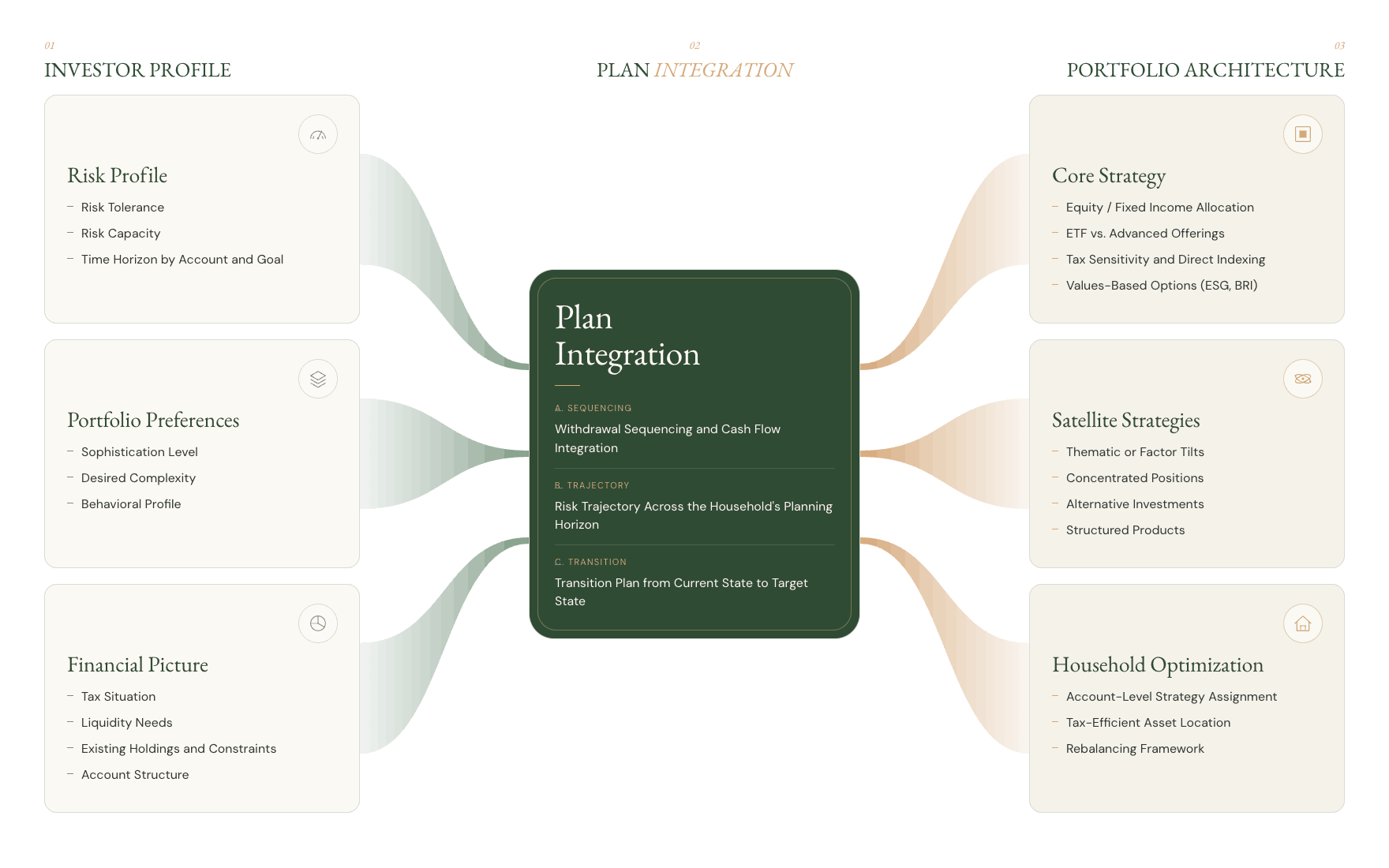
Every portfolio begins with a thorough assessment of what matters most. We evaluate the relevant goals for each account, review existing holdings and their tax implications, understand liquidity needs, and develop a clear picture of each client's risk tolerance and investment preferences.
From there, we build from the top down. Asset allocation is established at the household level first, ensuring that all accounts work together as a cohesive whole rather than in isolation. Then, allocation decisions are made at the account level, strategies are designed for each account's specific purpose, and individual models and positions are selected to bring it all together.
The result is a portfolio built with intention at every level, each component selected for its specific purpose rather than applied uniformly across the board.
At the heart of most client portfolios is a sophisticated, research-driven investment strategy developed and managed by the McAdam Financial investment team. Known as Strategic Diversification Services (SDS), this program serves as the foundation upon which each personalized portfolio is built.
SDS is grounded in decades of academic portfolio research, beginning with Modern Portfolio Theory and incorporating later advancements in the field. The approach combines top-down macroeconomic analysis with rigorous bottom-up investment selection, targeting an asset allocation that is appropriate for each client's risk profile and objectives. Portfolios are broadly diversified across asset classes, actively monitored, and systematically rebalanced to maintain their intended structure over time.
The result is a disciplined, process-driven core that helps to remove emotion from the equation and keeps portfolios aligned with their long-term objectives.
Strategic Diversification Services (SDS)
Satellite strategies
While the core strategy provides a disciplined and diversified foundation, there are circumstances where additional customization can add meaningful value. Satellite strategies are portfolio supplements layered on top of the core, used selectively and intentionally based on each client's specific situation, goals, and preferences.
These strategies are not applied universally. They are evaluated on a case by case basis and implemented only where there is a clear and deliberate purpose within the context of the broader portfolio.
Examples of satellite strategies we may employ include:
Thematic or factor based tilts, such as targeted exposure to specific sectors, market factors, or economic themes
Concentrated positions or individual stock portfolios for clients with specific preferences or existing holdings to account for
Alternative investments, including strategies designed to provide diversification beyond traditional stocks and bonds
Structured products and defined outcome strategies for clients seeking specific risk and return parameters
Seeing it through
Even the best constructed portfolio can be undermined by the investor behind it. Research consistently shows that the returns investors actually earn fall meaningfully short of the returns their investments produce, not due to poor portfolio construction, but due to poorly timed decisions driven by emotion.
Morningstar's Mind the Gap study found that over the ten year period ending December 2023, investors forfeited roughly 1.1% per year through mistimed purchases and sales. DALBAR's research puts the long-term gap between market returns and average investor returns at 2.84% annually over 30 years.
A disciplined investment process and a trusted advisor relationship are among the most effective tools for closing that gap. Having someone to provide perspective when markets are uncertain, reinforce the reasoning behind your plan, and help you stay the course is just as valuable as the portfolio itself.
The SDS Investment Process
Top-Down Analysis
We start with the big picture. Macroeconomic conditions, market cycles, and your risk capacity inform a strategic asset allocation target, the framework every portfolio decision is built on.
Bottom-Up Analysis
From there, individual securities and funds are evaluated on their merits. Fundamentals, costs, tax efficiency, and quality determine what earns a place in your portfolio.
Portfolio Construction
Allocation targets and selected holdings are assembled into a portfolio built around your specific goals, tax situation, and risk tolerance, then implemented with discipline.
Advanced Rebalancing
Markets drift. We rebalance with intention, capturing tax-loss harvesting opportunities and keeping allocations aligned with your plan rather than chasing performance.
On-Going Monitoring
Continuous oversight keeps your strategy current as your life, the markets, and tax law evolve. We refine as needed and start the cycle again.
This rarely sits alone.
Tax Planning
Taxes are one of the largest expenses most people will ever face. We help you reduce what you owe not just today, but in every year ahead.
Cash Flow Management
Most financial plans are built on assumptions about spending. We help you make sure those assumptions are accurate.
Retirement Planning
The shift from accumulation to distribution is one of the most consequential transitions in your financial life. We help you navigate it.