
The Hidden Tax Problem of Required Minimum Distributions
How RMDs quietly reshape your tax picture, and what to do before they start
Required minimum distributions force taxable withdrawals from traditional IRAs and 401(k)s beginning at age 73 or 75 depending when you were born. For many retirees, those withdrawals arrive at the worst possible time: stacked on top of Social Security income, investment gains, and other sources, pushing total taxable income well into territory they never anticipated. The tax consequences can be significant, and they compound over time.
This piece outlines how RMDs create tax problems, and some of the most effective strategies for managing them. No approach works for everyone. The right combination depends on your income sources, estate goals, account structure, and timeline.
Why RMDs Create Tax Problems
The issue is not the withdrawal itself. It is the way a large, mandatory withdrawal interacts with the rest of your income picture.
Bracket Creep
Most retirees draw income from multiple sources: Social Security, taxable investment accounts, pensions, and part-time work. Add a five- or six-figure RMD on top, and income that looked manageable can land in a higher federal bracket. Because RMD amounts grow each year as account balances fluctuate and IRS life expectancy factors shift, this pressure tends to increase over time.
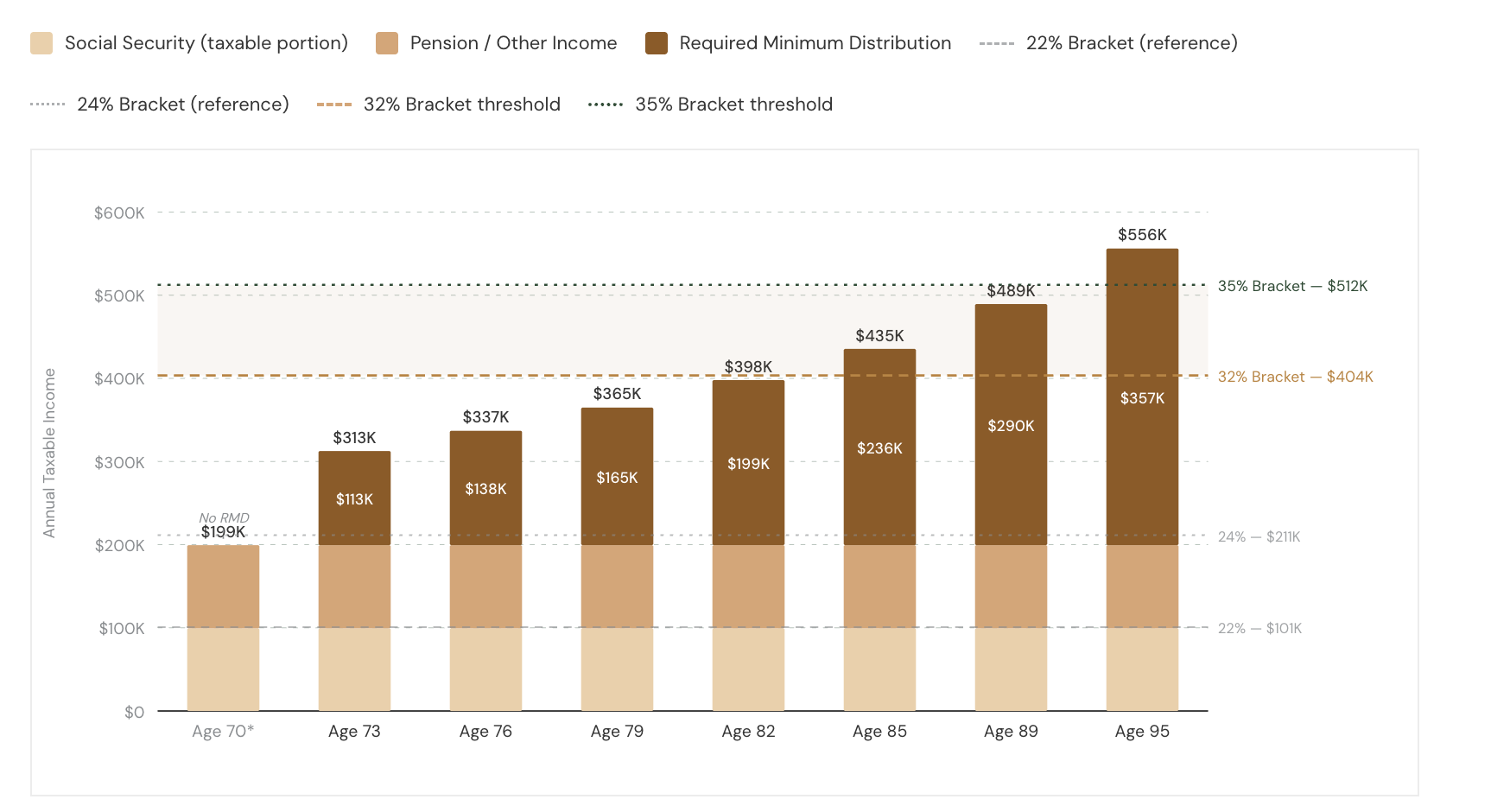
Sources: IRS Publication 590-B, Uniform Lifetime Table (2024) — irs.gov/publications/p590b · IRS Rev. Proc. 2025-32 (2026 MFJ brackets) — irs.gov/pub/irs-drop/rp-25-32.pdf · SSA Maximum Benefit at Age 70 (2026) — ssa.gov. Hypothetical illustration. *Age 70 is a pre-RMD reference point; RMDs begin at age 73 under current law.
Capital Gains Threshold Exposure
Federal long-term capital gains rates are tiered by total taxable income, not by the nature of the asset. In 2026, the 0% rate applies up to $98,900 for married filers and $49,450 for single filers. The 15% rate applies on income above those thresholds up to $600,050 (MFJ) or $533,400 (single). Above those levels, the rate rises to 20%.
An RMD that pushes total taxable income past the 0% threshold converts what would have been tax-free gains into taxable ones at 15% or 20%. For retirees holding appreciated positions in taxable accounts, this interaction is easy to miss in year-end planning. A distribution you did not need for living expenses can inadvertently trigger capital gains tax on assets you had no intention of selling.
Beyond the federal rate, most states also tax capital gains as ordinary income, with rates ranging from roughly 3% to over 13% depending on the state. The combined federal and state cost of crossing a gains threshold can be substantially higher than the federal rate alone.
The Social Security Tax Trap
Up to 85% of Social Security benefits are taxable once combined income exceeds $44,000 for married filers. RMDs count toward that calculation. A retiree who would otherwise pay tax on 50% of their benefits may find themselves at the 85% threshold solely because of a mandatory IRA withdrawal they did not need for living expenses.
IRMAA Surcharges
Medicare Part B and Part D premiums are income-tested. In 2026, surcharges begin at $109,000 MAGI for single filers and $218,000 for married filers. The thresholds are based on income from two years prior — so current-year income determines Medicare costs two years out. IRMAA operates as a cliff: exceeding a threshold by one dollar triggers the full surcharge for the entire year, not just on the excess. A single unplanned RMD can push a household into a higher tier and keep it there for two premium years.
~$2,300 — the annual IRMAA surcharge for a married household in the lowest surcharge tier (2026). Because the cliff applies the full surcharge for the whole year, a one-time spike from an unplanned RMD can trigger this across two full premium years.
Source: CMS 2026 Part B and Part D premium schedules. For illustrative purposes only.
Net Investment Income Tax (NIIT)
The net investment income tax adds a 3.8% surtax on investment income — interest, dividends, capital gains, rental income — once MAGI exceeds $200,000 for single filers or $250,000 for married filers. Unlike ordinary income brackets, the NIIT threshold is not indexed to inflation, meaning more households reach it each year without any real increase in purchasing power.
RMDs create direct exposure here. A retiree whose investment income sits just below the threshold can cross it in any year when a mandatory distribution pushes MAGI over the limit. The result is a 3.8% surcharge on investment income that was not previously subject to it — stacking on top of the ordinary income tax already owed on the distribution itself. For households with meaningful taxable account income, the combined effect is significant.
Penalty Risk
Failing to take a required minimum distribution triggers a 25% excise tax on the amount not withdrawn, reduced to 10% if corrected promptly. For inherited IRAs, the rules are more complex and the risks are higher. Beneficiaries operating under the 10-year rule introduced by the SECURE Act face mandatory full depletion by the end of the tenth year, with specific annual requirements depending on whether the original account holder had already begun distributions.
Estate and Beneficiary Consequences
Large pre-tax accounts transferred at death pass their deferred tax liability to heirs. Non-spouse beneficiaries under the SECURE 2.0 framework generally must empty inherited accounts within 10 years. A $1.5 million IRA left to an adult child in peak earning years can generate an outsized tax event at exactly the wrong time. The account that looked like a gift may function more like a tax bill.
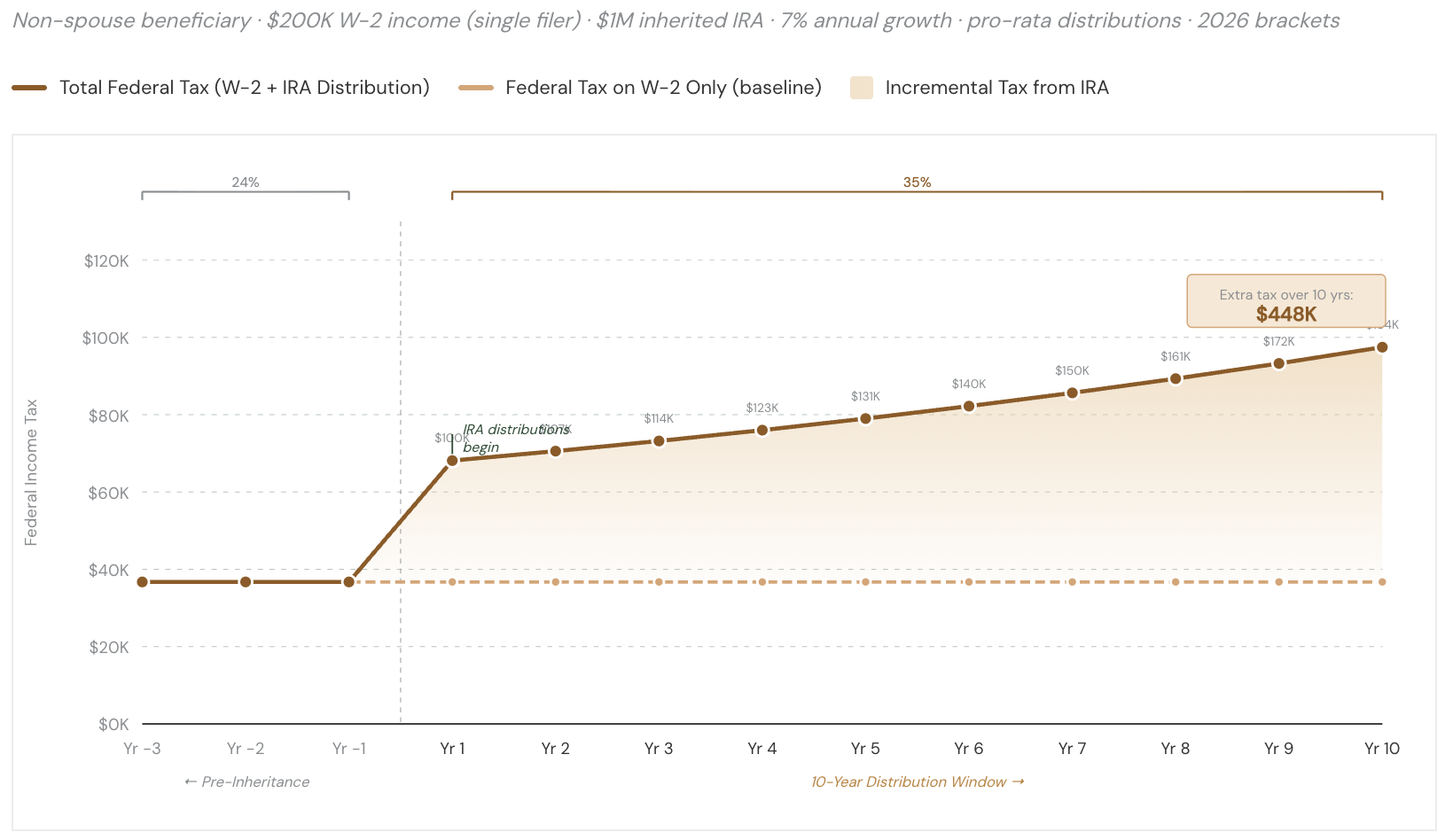
The tax cost of a poorly managed RMD strategy is not just what you pay this year. It is what accumulates across decades of compounding — and what your beneficiaries inherit.
Strategies for Managing the Tax Burden
There is no single solution. The right approach depends on account balances, income needs, estate priorities, and the years remaining before distributions begin. What follows is an overview of the most commonly applied strategies.
Roth Conversions
Converting pre-tax IRA or 401(k) assets to a Roth account accelerates the tax hit but does so on your terms, at a rate and timing you control. Assets held in Roth accounts are not subject to RMDs during the owner's lifetime, grow tax-free, and pass to heirs without embedded tax liability. The strategy works best in the years between retirement and RMD onset, when income is often lower and there is capacity to fill lower brackets deliberately. Conversions done over multiple years can reduce future RMD balances significantly without creating a single-year income spike.
Social Security Timing
Delaying Social Security benefits to age 70 generates an 8% annual credit for each year past full retirement age. But the timing decision also affects the RMD interaction. Taking Social Security early while beginning RMDs at 73 stacks two income sources that can push above key thresholds. Delaying Social Security while drawing down pre-tax accounts in the gap years reduces the future account balance subject to RMDs and can preserve more favorable tax treatment across both income streams.
Asset Location Optimization
Where assets are held matters as much as what assets are held. Tax-inefficient investments — bonds, REITs, high-turnover funds — belong inside pre-tax accounts, where the income they generate is deferred. Growth-oriented equities belong in Roth or taxable accounts, where gains compound more favorably. This structure reduces the taxable portion of future RMDs and limits the ongoing income drag from the taxable account — interest, short-term gains, and non-qualified dividends are all taxed as ordinary income annually, whether spent or not. Reserving the taxable account for buy-and-hold equities, index funds, and tax-managed strategies keeps the annual income footprint low and preserves bracket capacity for RMDs.
Strategic Distribution Ordering
The sequence in which you draw from accounts in early retirement can meaningfully affect the balance subject to RMDs at 73. Drawing strategically from pre-tax accounts before RMDs begin, rather than defaulting to taxable accounts, reduces the future required amount. This requires modeling the interaction between current tax cost and future distribution pressure — which changes depending on expected rates, account growth, and income needs.
Charitable Giving Strategies
For charitably inclined retirees, several vehicles offer meaningful tax benefit relative to simply taking a distribution and donating the proceeds.
A qualified charitable distribution (QCD) allows investors aged 70½ or older to transfer up to $111,000 directly from an IRA to a qualified charity in 2026. The transfer counts toward the RMD and is excluded from adjusted gross income entirely — keeping income off the MAGI calculation, reducing taxable Social Security, and helping avoid IRMAA surcharges. For regular givers, this is often the most efficient tool available.
A donor-advised fund (DAF) allows a larger, one-time deductible contribution in a high-income year, with the flexibility to distribute grants to charities over time. It can be particularly effective in a year when a large RMD or Roth conversion pushes income higher than usual.
For larger estates, a charitable remainder trust (CRT) can accept appreciated assets or IRA proceeds, provide an income stream to the donor during their lifetime, and transfer remaining assets to charity at death. CRTs involve more complexity and cost, but can serve both income and estate planning goals simultaneously. Suitability varies substantially by situation.
Additional Strategies Worth Discussing
Depending on your specific circumstances, the following may also be relevant:
Life insurance as a tax-free death benefit vehicle, funded in part by RMD proceeds
Testamentary trust structures to manage the inherited IRA 10-year distribution requirement for beneficiaries
Gifting strategies during lifetime to reduce estate size and future RMD exposure
Defined benefit plan considerations for still-working business owners approaching RMD age
Net unrealized appreciation (NUA) treatment for employer stock held in a 401(k)
The most effective RMD strategies require years of lead time. Roth conversions, distribution sequencing, and Social Security coordination all depend on decisions made well before age 73. The window for meaningful action is narrower than most people assume.
Building a Strategy Around Your Situation
The strategies outlined here are not mutually exclusive, but they are not all appropriate for every household. A Roth conversion that makes sense for one person may generate a problematic income spike for another. The order in which you deploy these tools, and the years in which you act, determines the outcome.
We work with clients to model these interactions in advance, identify the strategies that apply to their situation, and build a coordinated plan across accounts, income sources, and timeline. If you are within ten years of RMD age, or already taking distributions and looking for a more tax-efficient approach, the time to review is now.
Sources & Disclosures
Sources
Internal Revenue Service. "Publication 590-B: Distributions from Individual Retirement Arrangements." Updated annually. irs.gov/publications/p590b
Internal Revenue Service. "Retirement Topics: Required Minimum Distributions (RMDs)." irs.gov
Centers for Medicare & Medicaid Services. "2026 Medicare Parts B and D Premiums and IRMAA Thresholds." cms.gov/medicare
Social Security Administration. "Income Taxes and Your Social Security Benefits." ssa.gov
Congress.gov. "SECURE 2.0 Act of 2022." Division T of the Consolidated Appropriations Act, 2023. congress.gov
IRS Revenue Procedure 2025-32. "2026 QCD Limit ($111,000), Tax Brackets, and Standard Deductions." irs.gov/pub/irs-drop/rp-25-32.pdf
Social Security Administration. "Delayed Retirement Credits." ssa.gov
Internal Revenue Service. "Questions and Answers on the NetInvestment Income Tax." irs.gov
IRS Revenue Procedure 2025-32. 2026 Federal Income Tax Brackets, Standard Deductions, and Capital Gains Thresholds. irs.gov/pub/irs-drop/rp-25-32.pdf
IRS. "Topic No. 409: Capital Gains and Losses." irs.gov/taxtopics/tc409
Methodology & Disclosures
General. All figures are hypothetical illustrations prepared for educational purposes only. They do not represent any actual client, account, or investment outcome. Results will vary materially based on individual circumstances. Nothing herein constitutes investment, tax, or legal advice. Consult a qualified professional before making financial decisions.
Tax brackets. Federal income tax brackets reflect 2026 IRS schedules per IRS Rev. Proc. 2025-32. Key thresholds used: 32% begins at $201,775 (single) / $403,550 (MFJ); 35% at $256,225 / $512,450; 37% at $640,600 / $768,700. Standard deduction: $16,100 single, $32,200 MFJ. Long-term capital gains thresholds: 0% up to $49,450 (single) / $98,900 (MFJ); 15% up to $533,400 / $600,050; 20% above. Brackets are adjusted annually by the IRS using the Chained CPI; future thresholds will differ. TCJA bracket structure was made permanent under the One Big Beautiful Bill Act (OBBBA), signed July 2025. No state or local income taxes included. Future tax laws, Medicare rules, Social Security regulations, and IRS guidance may change and could materially impact the assumptions and outcomes illustrated herein.
Figure 1 -- RMD methodology. Starting IRA balance: $3,000,000 at age 73. Annual RMD calculated as account balance divided by the IRS Uniform Lifetime Table divisor for that age (2024 revision). Balance is reduced by each year's RMD; remainder grows at a fixed 7% annual rate before the next RMD is calculated. Ages shown: 70, 73, 76, 79, 82, 85, 89, 95. Age 70 is a pre-RMD reference point; RMDs begin at age 73 under current law.
Figure 1 -- income sources. Social Security: maximum combined benefit for a married couple both claiming at age 70 (2026 SSA maximum approximately $4,873/month per spouse = ~$116,952/year combined; see ssa.gov for current figures). 85% of combined SS treated as taxable per IRS provisional income rules (IRS Publication 915). Taxable SS portion (~$99,400) held constant across all ages; no COLA applied. In practice, SSA applies an annual COLA, increasing the taxable SS amount over time and compounding bracket pressure. Pension/other income: $100,000/year, held constant; no inflation adjustment.
Figure 2 -- distribution methodology. Starting inherited IRA balance: $1,000,000. Non-spouse beneficiary subject to SECURE 2.0 10-year rule. Distribution method: pro-rata spread (Year 1: balance ÷ 10; Year 2: balance ÷ 9; continuing to Year 10: full remaining balance). After each distribution, remaining balance grows at 7% before the next year's calculation. Three pre-inheritance reference years shown at the W-2 baseline to illustrate the tax step-up when distributions begin.
Figure 2 -- income sources. W-2 income: $200,000/year, held constant; no inflation adjustment. $16,100 standard deduction (2026 single filer) applied. IRA distributions treated as fully taxable ordinary income. No other income sources included; additional sources would compound the bracket effects shown. Marginal rate annotation reflects the top bracket applicable to total taxable income (W-2 + distribution, after standard deduction).
Rate of return. 7% fixed annual rate used in both figures. Illustrative only; does not represent any specific investment, index, or strategy. Actual returns will vary and may be negative. Illustrations do not reflect investment management fees, advisory fees, transaction costs, insurance product expenses, or other account-level expenses, all of which would reduce actual results. The fixed rate eliminates sequence-of-returns variability for clarity; in practice, variable returns would cause RMD amounts and account balances to fluctuate
Inflation and purchasing power. Neither model adjusts income sources or distributions for inflation. Bracket thresholds reflect 2026 IRS schedules and are indexed annually using the Chained CPI; future years will differ. SS income in Figure 1 is held constant despite SSA's annual COLA, understating the real bracket pressure in later ages. The directional conclusion -- that RMDs and inherited IRA distributions materially increase taxable income and effective tax rates -- holds under a wide range of assumptions.
Insurance and compensation. Donohue Wealth Management is a DBA of McAdam LLC, an SEC registered investment adviser. Insurance products and services are offered through licensed insurance agents affiliated with McAdam Financial. Matt Donohue may receive commissions on certain insurance products, which represents a potential conflict of interest. Clients and prospects are encouraged to ask about all compensation arrangements. Registration as an investment adviser does not imply a certain level of skill or training.