
The Mega Backdoor Roth: A Powerful Strategy Often Overlooked
If you’ve already maxed out your standard 401(k) contributions and you’re looking for ways to save even more on a tax-advantaged basis, there’s a strategy worth knowing about. It’s called the Mega Backdoor Roth, and for those whose plans support it, it may provide the ability to make significant additional Roth contributions each year.
The Standard Limits Don’t Tell the Full Story
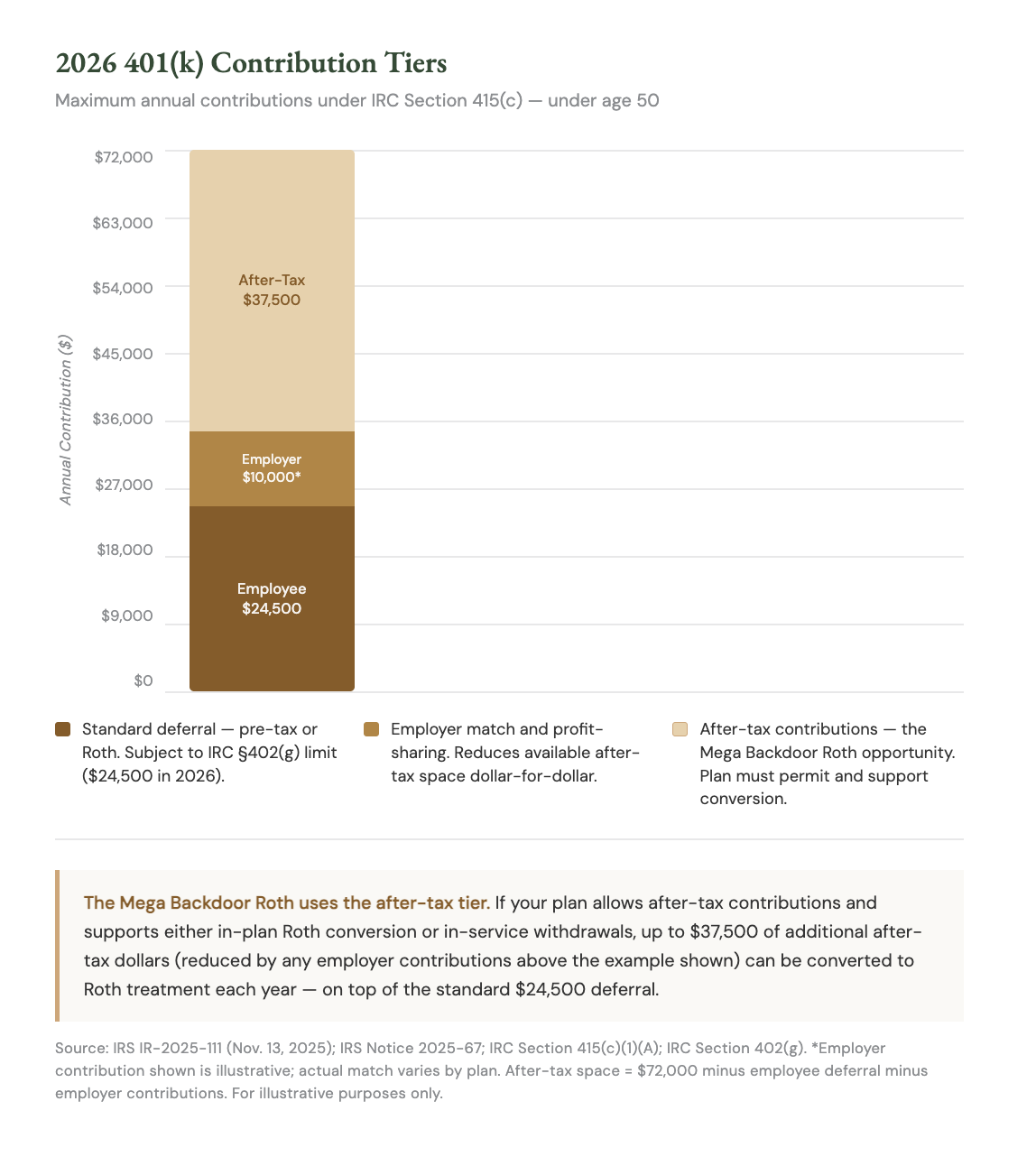
For 2026, the IRS set the employee deferral limit for 401(k) plans at $24,500. [1] Most people treat that as the ceiling. It isn’t.
There is a second, broader limit that many savers never encounter. Under IRC Section 415(c), the total amount that can go into your 401(k) from all sources combined, including your own contributions, your employer’s match or profit-sharing, and something called after-tax contributions, is $72,000 for 2026. [2,3] The gap between your $24,500 personal deferral and that $72,000 ceiling (reduced by whatever your employer contributes) is where the Mega Backdoor Roth lives. Most people never access this space. But if your plan supports it, you can.
How It Works
The strategy has three parts: you contribute to your 401(k) on an after-tax basis beyond your standard deferral, you convert those after-tax dollars to Roth, and from that point forward they grow tax-free, with qualified distributions generally received free from federal income tax.
It helps to understand that a 401(k) can hold three different types of contributions: pre-tax dollars (the kind that reduce your taxable income today), Roth dollars (contributed after tax, growing tax-free), and a third category called after-tax contributions. This third bucket is less commonly known and not available in every plan, but it’s the engine behind the Mega Backdoor Roth.
On their own, after-tax contributions are not particularly tax-advantaged. They grow tax-deferred, and any earnings are taxable when you withdraw them. The key is converting them to Roth status before significant earnings accumulate. Once converted, the assets receive Roth tax treatment, and qualified distributions may generally be received free from federal income tax.
There are two ways to complete the conversion. The first is an in-plan Roth conversion, where the after-tax balance is converted directly to a Roth 401(k) designation inside your existing plan. This approach avoids the IRA aggregation rule (IRC Section 408(d)(2)) [4], meaning only any earnings that have accumulated in the after-tax account are taxable at conversion, not the amount you originally contributed.
The second option is an in-service distribution, where the after-tax funds are rolled out to an external Roth IRA while you are still employed. Under IRS Notice 2014-54 [5], you can split the distribution: your after-tax contributions go to a Roth IRA tax-free, and any pre-tax earnings go separately to a traditional IRA. This keeps the conversion clean, but the mechanics need to be handled correctly. Working with a tax professional on this step is important to avoid any unintended taxable income on the earnings portion.
Timing matters with both approaches. The longer after-tax contributions sit unconverted, the more earnings accumulate and become taxable at conversion. Converting promptly after each payroll cycle, ideally as soon as the contribution is posted, keeps the taxable amount as small as possible.
Does Your Plan Support This?
This is the first question to answer, because not every 401(k) offers the features needed.
To use this strategy, your plan document must specifically allow two things: after-tax contributions beyond the standard deferral limit, and either an in-plan Roth conversion or an in-service distribution right. You need both. A plan that permits after-tax contributions but offers no conversion or withdrawal mechanism leaves that money stranded, growing tax-deferred but never reaching Roth status.
Many large employer plans do support both features, though availability varies by plan size and sponsor. Smaller plans are less likely to offer them. According to the Plan Sponsor Council of America and similar industry surveys, the share of plans permitting after-tax contributions alongside a conversion or in-service withdrawal right is meaningfully higher among large employers, but it is still far from universal even at large companies. [6,7] If your plan does not currently support the strategy, there is no individual workaround. The plan document itself would need to be amended by your employer.
The easiest place to start is your plan’s Summary Plan Description, or a quick call to your HR department or plan administrator. Ask specifically whether voluntary after-tax contributions are permitted, and whether an in-plan Roth conversion or in-service withdrawal right exists.
Two Places the Money Can Go
Once you complete the conversion, where the money lands has real implications for how it behaves going forward.
With an in-plan Roth conversion, the money stays inside your 401(k) but moves to a Roth designation. It remains subject to plan rules, though since 2024 designated Roth accounts in employer plans are no longer subject to required minimum distributions during your lifetime. [8] It also retains the strong creditor protections that come with ERISA-qualified plans, which can be meaningful depending on your situation.
With an in-service distribution to a Roth IRA, the money leaves the plan entirely and moves to an account in your name outside of work. Roth IRAs offer more flexibility, including a broader investment menu and the ability to access your converted after-tax contributions without penalty, since only the taxable portion of a conversion is subject to the early withdrawal penalty. Earnings are different: they come out tax-free only once you are 59½ and your Roth IRA has satisfied its own five-year holding period, which does not carry over from the plan. [9] The trade-off is that assets held in a Roth IRA lose ERISA creditor protection.
For most people with an existing Roth IRA or a preference for long-term flexibility, the Roth IRA route may be seen as an attractive option. That said, your specific situation matters, and it is worth reviewing both paths with your advisor.
What If My Plan Allows After-Tax Contributions but Not Conversion?
This is worth knowing about before you assume the strategy is fully available to you.
Some plans allow after-tax contributions but prohibit both in-plan conversions and in-service distributions. If that describes your plan, those after-tax dollars are stuck. They grow tax-deferred, but earnings will be taxed as ordinary income when you withdraw them. Without a path to Roth treatment, after-tax contributions in this situation offer little real advantage over investing in a regular taxable brokerage account.
If you find yourself in this situation, ask your plan administrator directly whether a conversion right or in-service withdrawal option exists. If neither is available, your energy is probably better spent on other Roth strategies.
The Real Advantages
For those whose plans fully support the strategy, the benefits are significant.
There are no income limits. Direct Roth IRA contributions phase out once income reaches certain thresholds (for 2026, the phase-out begins at $153,000 for single filers and $242,000 for married couples filing jointly). [1] The Mega Backdoor Roth has no such restriction. Any employee in a qualifying plan can use it, regardless of how much they earn.
The savings potential is substantial. For 2026, after-tax contribution space can reach up to $47,500 before accounting for employer contributions. [2,3] That is significantly more than the $7,500 direct Roth IRA limit [1], and it stacks on top of your regular 401(k) deferral.
And once the money is in Roth, it grows completely free of federal income tax. For someone with many years until retirement, the long-term compounding benefit of tax-free growth compared to a taxable or tax-deferred account can add up to a great deal over time.
A Few Things to Keep in Mind
Plan availability is never guaranteed. The strategy only works if your employer has built the necessary features into the plan document. There is nothing you can do on your own if they have not.
If you are a highly compensated employee, your after-tax contributions are subject to annual nondiscrimination testing under the Actual Contribution Percentage test. [10] If other employees do not contribute enough to satisfy the test, your after-tax contributions may be refunded, which would undo the strategy for that year. This is a plan-level compliance issue, not something you control.
Any investment gains that accumulate between your contribution and the conversion are taxable. The more often the plan can process conversions, the smaller this exposure tends to be.
If you use the in-service distribution route, you may receive multiple 1099-R forms in a given tax year. The tax reporting can be a bit involved, so having a tax professional in your corner is genuinely helpful here.
One clarification worth noting: catch-up contributions for those age 50 and older apply to the elective deferral limit [11], not to the after-tax bucket. Your after-tax contribution space is simply the gap between total contributions and the $72,000 Section 415(c) ceiling [3], and that calculation does not change based on age.
Is This Right for You?
The starting point is a straightforward check: does your plan allow after-tax contributions, and does it offer an in-plan Roth conversion or in-service distribution right? Many people have simply never asked.
If the features are there, the next question is whether this strategy makes sense for your specific situation, taking into account your current tax bracket, your expected income in retirement, what other Roth savings you already have, and how you would otherwise put those dollars to work.
We’re happy to help you think through both questions. Reach out to schedule a conversation, and we can review your plan documents together and determine whether the Mega Backdoor Roth belongs in your savings plan.
Sources
1. IRS IR-2025-111, Nov. 13, 2025. “401(k) limit increases to $24,500 for 2026, IRA limit increases to $7,500.” Internal Revenue Service. Covers the 2026 elective deferral limit and the Roth IRA income phase-out ranges cited in this article. https://www.irs.gov/newsroom/401k-limit-increases-to-24500-for-2026-ira-limit-increases-to-7500
2. IRS Notice 2025-67. Cost-of-living adjustments affecting dollar limitations for pension plans and other retirement-related items for tax year 2026. Internal Revenue Service. Source for the 2026 IRC Section 415(c) annual additions limit of $72,000. https://www.irs.gov/pub/irs-drop/n-25-67.pdf
3. IRC Section 415(c)(1)(A). Annual additions limit for defined contribution plans. U.S. Code. https://www.law.cornell.edu/uscode/text/26/415
4. IRC Section 408(d)(2). Taxation of individual retirement account distributions (the IRA aggregation/pro-rata rule referenced in the in-plan conversion discussion). U.S. Code. https://www.law.cornell.edu/uscode/text/26/408
5. IRS Notice 2014-54. Guidance on the tax treatment of amounts rolled over from an eligible retirement plan to a designated Roth account. Internal Revenue Service. https://www.irs.gov/pub/irs-drop/n-14-54.pdf
6. Plan Sponsor Council of America, 67th Annual Survey of Profit Sharing and 401(k) Plans (2024, reflecting 2023 plan-year data), as reported in “Top 10 Highlights from PSCA’s Newest Survey of 401(k) Plans,” 401(k) Specialist. Reports that roughly 60% of surveyed plans allow in-plan Roth conversions. https://401kspecialistmag.com/top-10-highlights-from-pscas-newest-survey-of-401k-plans/
7. Congressional Research Service, “Rollovers and Conversions to Roth IRAs and Designated Roth Accounts,” IF11963. Library of Congress. Cites a Plan Sponsor Council of America survey finding 20.9% of plans permitted after-tax contributions and 56.3% permitted in-service (non-hardship) distributions, with availability skewing higher among larger plan sponsors. https://www.congress.gov/crs-product/IF11963
8. SECURE 2.0 Act of 2022 (P.L. 117-328), Section 325, as described in Congressional Research Service, “Required Minimum Distribution Rules,” IF12750. Removed the RMD requirement for designated Roth accounts in employer plans, effective 2024. https://www.congress.gov/crs-product/IF12750
9. IRC Section 408A(d) and IRS Publication 590-B. Roth IRA distribution ordering rules, the five-year holding period, and the treatment of converted amounts. Internal Revenue Service. https://www.irs.gov/publications/p590b
10. IRC Section 401(m). Nondiscrimination test for matching contributions and employee contributions (the Actual Contribution Percentage test). U.S. Code. https://www.law.cornell.edu/uscode/text/26/401
11. IRC Section 414(v). Catch-up contributions for participants age 50 and over. U.S. Code. https://www.law.cornell.edu/uscode/text/26/414
Note: Contribution limits are adjusted annually for inflation. Verify current-year figures at IRS.gov before acting.
Disclosure
This article is provided by McAdam LLC (“McAdam” or the “Firm”) for informational purposes only. Investing involves the risk of loss, and investors should be prepared to bear potential losses. Past performance may not be indicative of future results and may have been impacted by events and economic conditions that will not prevail in the future. No portion of this article is to be construed as a solicitation to buy or sell a security or the provision of personalized investment, tax, or legal advice. Certain information contained in this report is derived from sources that McAdam believes to be reliable; however, the Firm does not guarantee the accuracy or timeliness of such information and assumes no liability for any resulting damages.
Securities offered only by duly registered individuals through Madison Avenue Securities, LLC (MAS), member FINRA/SIPC. Investment advisory services offered only by duly registered individuals of McAdam, LLC, a registered investment advisor. Insurance products and services offered through McAdam Financial. Donohue Wealth Management DBA McAdam, LLC and McAdam Financial are not affiliated with MAS.
Chart data sourced from IRS IR-2025-111 and IRS Notice 2025-67. Employer contribution shown is illustrative. For illustrative purposes only. Individual results will vary.