
An Exploration of Tax Alpha and Direct Indexing
How owning the underlying index rather than a fund of it can meaningfully improve your after-tax returns.
What Is Tax Alpha?
Most conversations about investment performance center on what a portfolio earns before taxes. But for investors in taxable accounts, what you keep after taxes matters far more than the gross return on paper. Tax alpha is the additional after-tax return generated by implementing tax-aware strategies within a portfolio. It is not about finding better investments. It is about keeping more of what your investments already produce.
The primary tool for generating tax alpha is tax-loss harvesting: the practice of selling securities that have declined in value to realize a capital loss, then immediately reinvesting the proceeds in a similar position to maintain market exposure. The realized loss can offset capital gains elsewhere in your portfolio, reducing your tax liability in the current year. Done well, this practice can defer taxes over many years, effectively keeping more of your capital compounded and working on your behalf.
The concept is straightforward. The execution is where most investors fall short.
Tax-Loss Harvesting: The Foundation
The mechanics of tax-loss harvesting begin with a basic principle of the tax code: realized capital losses can offset realized capital gains dollar-for-dollar. If you sell a position at a $20,000 gain and another at a $15,000 loss in the same year, you are only taxed on the net $5,000 gain. If losses exceed gains in a given year, up to $3,000 of excess losses can be deducted against ordinary income, with any remainder carried forward indefinitely to offset future gains.
The critical distinction is that losses must be realized to be useful. Unrealized losses sitting in a portfolio do nothing for your tax bill. Tax-loss harvesting is the act of making them count.
One important rule governs this strategy: the wash-sale rule. Under IRS rules, if you sell a security at a loss and repurchase the same or a substantially identical security within 30 days before or after the sale, the loss is disallowed. The practical workaround is to immediately reinvest the sale proceeds into a similar but not substantially identical position, maintaining your market exposure while the loss is recognized for tax purposes.
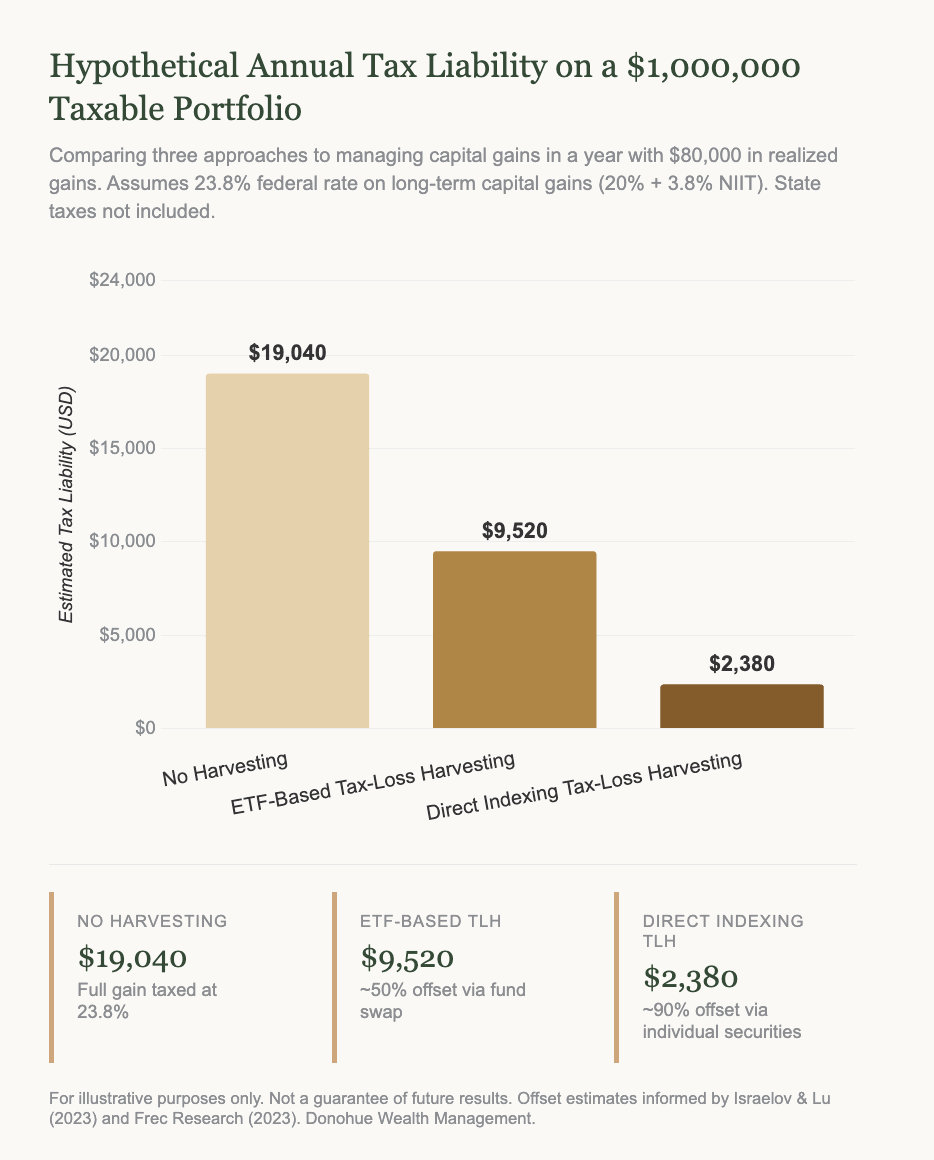
*Results will vary based on portfolio holdings, tax rates, realized gains, market conditions and implementation. Not a prediction of actual tax savings.
For an investor relying on ETFs or mutual funds, tax-loss harvesting is limited in scope. You can sell a fund at a loss and replace it with a comparable fund. But the fund itself is a black box: you cannot reach inside and harvest individual positions that may have declined while the broader fund remained positive. That limitation is where direct indexing changes the equation.
Direct Indexing: A More Precise Instrument
Direct indexing is a strategy in which an investor holds the individual securities that make up an index, rather than purchasing a fund that holds them on their behalf. Instead of owning one ETF share that represents 500 companies, a direct indexing account holds positions in each of those companies directly.
This structure unlocks something a fund cannot provide: the ability to harvest losses at the level of individual securities, regardless of what the index is doing overall.
Consider what this means in practice. In 2023, the S&P 500 returned 26.3%. A strong year by any measure. Yet within that same index, 374 individual stocks spent some portion of the year below their starting price. For an investor who owned the index through an ETF, there was nothing to harvest. The fund was up. For a direct indexing investor who owned each of those stocks individually, there were hundreds of harvesting opportunities throughout the year, each generating losses that could offset gains elsewhere.
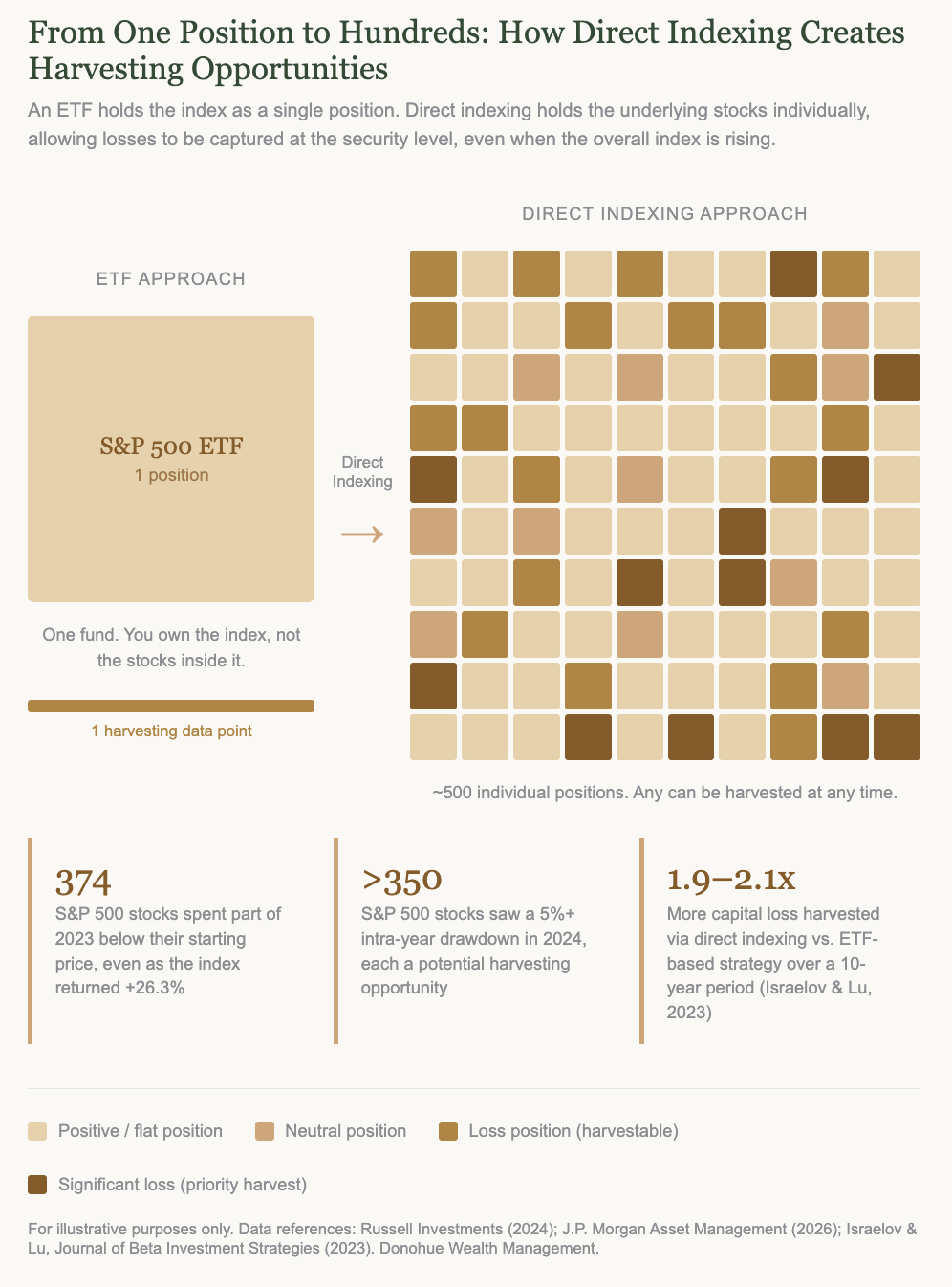
This is for conceptual and informational use only; this does not represent a recommendation to buy a specific product or investment.
J.P. Morgan Asset Management research found a similar pattern in 2024: while approximately 130 S&P 500 stocks ended the year with a drawdown of 5% or more, over 350 stocks experienced a 5% or greater drawdown at some point during the year. That is a meaningful difference between what is visible at year-end versus what is available throughout the year to a disciplined, continuously monitored strategy.
This is the core advantage of direct indexing: more data points, more harvesting opportunities, and a higher likelihood of finding losses even in positive markets.
How Much Can It Add? What the Research Shows
Quantifying the value of tax-loss harvesting and direct indexing is inherently imprecise, as the benefit depends heavily on an investor's tax situation, portfolio size, and how effectively the strategy is executed. That said, the body of research points consistently in one direction.
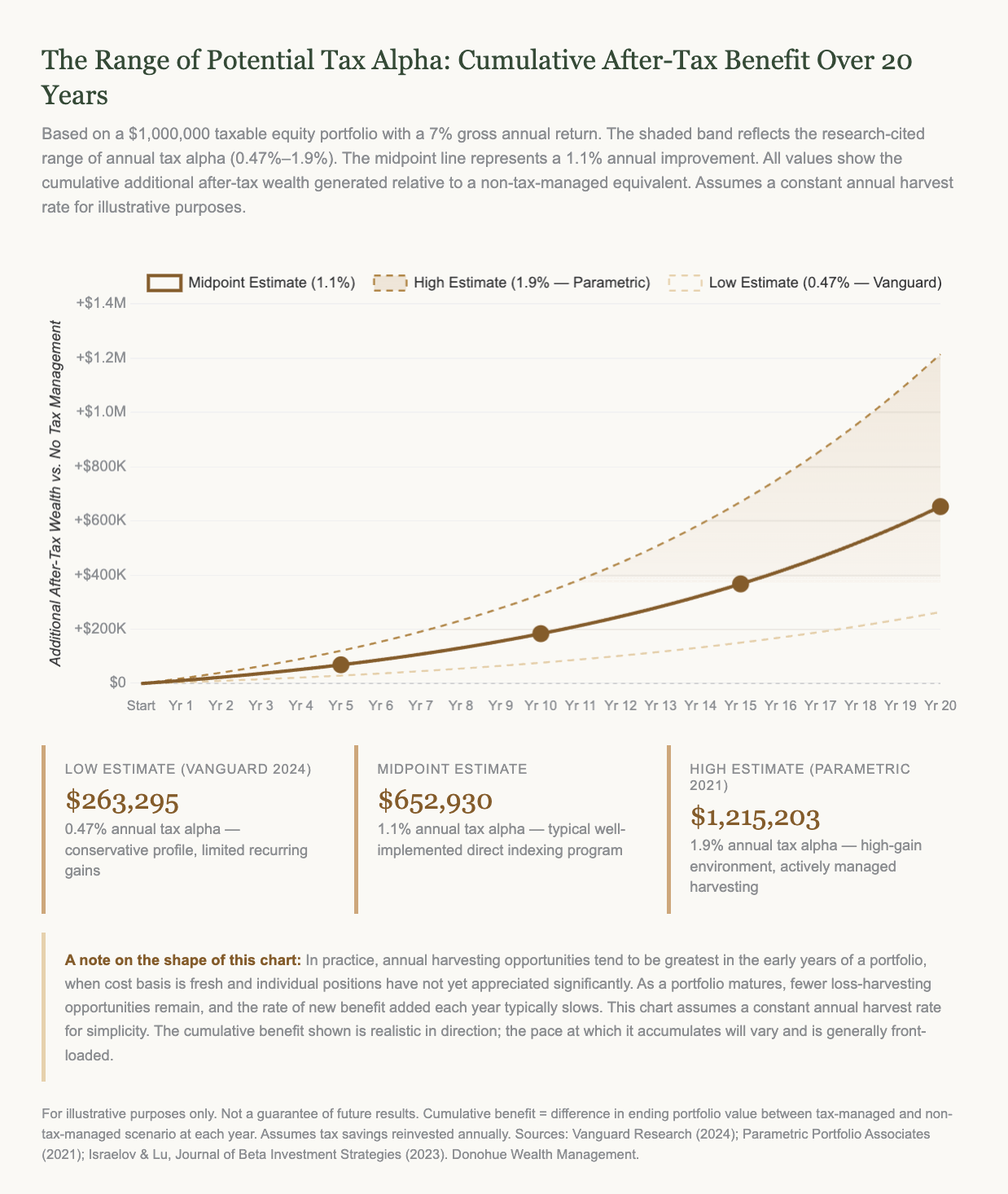
Vanguard's 2024 research found that tax-loss harvesting alpha, measured as the additional annual after-tax return from a well-executed program, ranges from approximately 0.47% to 1.27% annually over a 15-year period. Parametric Portfolio Associates, one of the leading practitioners of direct indexing, has estimated closer to 1.9% in annual tax alpha. Vanguard's Advisor's Alpha study separately identified tax-loss harvesting as contributing up to 150 basis points or more in value, ranking it second only to behavioral coaching among the quantifiable contributions an advisor can make.
Research comparing direct indexing to ETF-based harvesting specifically found that a direct indexing approach can harvest 1.9 to 2.1 times more capital loss than an ETF-based strategy over a 10-year period. A study published in The Journal of Beta Investment Strategies in 2023 confirmed this intuition: individual stock portfolios provide both greater harvesting opportunities and greater consistency, because losses at the security level can emerge even when the overall market is rising.
The range across studies is wide, 0.5% to 2% or more annually, because the benefit is not uniform. But across many scenarios and methodologies, a well-implemented strategy adds meaningful after-tax return over time. In a taxable account compounding over decades, even half a percent per year is significant.
What to Know Before Assuming It Is Right for You
Direct indexing and tax-loss harvesting are not universally beneficial. There are real limitations to understand before treating this as a default approach.
Tax Deferral, Not Tax Elimination
Harvesting a loss today lowers your cost basis on the replacement security. When that security is eventually sold, the gain will be larger than it otherwise would have been. The tax is deferred, not eliminated. That distinction matters, but it is easy to understate what deferral is actually worth.
Every dollar of tax not paid today remains invested and compounding on your behalf. Over a long time horizon, the difference between paying a tax now versus paying it years from now can be substantial, even if the rate never changes. The longer the deferral period, the more that capital has worked for you before it is ever owed to the government.
The benefit compounds further when deferral creates bracket flexibility. If you are able to delay realizing gains until a year when your income is lower, such as early retirement before Social Security and required minimum distributions begin, you may face a meaningfully lower tax rate on those gains when they are eventually recognized. In some cases, long-term capital gains can be realized at a 0% federal rate for investors within certain income thresholds. Deferring not just the timing but the rate at which gains are taxed is where tax alpha can extend well beyond what the initial harvest alone would suggest.
The strategy works best for long-term investors who can compound the deferred tax benefit over many years. And for those with the right circumstances, two exit paths can sidestep the deferred gain entirely. Appreciated securities donated to charity, whether directly or through a donor-advised fund, allow you to claim a deduction at full market value while the embedded gain is never recognized. Securities passed on at death receive a step-up in basis to their fair market value at that time, eliminating the capital gains exposure for your heirs entirely. For clients with charitable intent or estate planning objectives, these outcomes transform tax deferral from a timing advantage into a permanent one.
If you anticipate needing to liquidate the portfolio in the future without either of those exits available, or if tax rates rise significantly before the gains are recognized, the benefit of deferral can be partially or fully eroded. That context matters, and it is part of the conversation we have when evaluating whether this strategy fits your situation.
The Wash-Sale Rule Requires Careful Coordination
The wash-sale rule applies broadly: across all of your accounts and your spouse's accounts, including IRAs and 401(k) plans. Selling a stock in a taxable account and inadvertently buying it back in an IRA within 30 days permanently disallows the loss. Good execution requires visibility into your entire household financial picture, not just the direct indexing account in isolation.
Tracking Error Is a Real Trade-Off
A direct indexing portfolio is not the index. When positions are sold and replaced with substitutes to avoid the wash-sale rule, the portfolio deviates from the benchmark it is designed to track. Over time and with scale, sophisticated programs manage this tracking error carefully. But investors should understand that they are accepting some degree of divergence from index performance in exchange for the tax benefits.
Diminishing Returns Over Time
The greatest harvesting opportunities often arise in the early years of a portfolio, when cost basis is freshest and individual positions have not yet appreciated significantly. As the portfolio matures and positions accumulate embedded gains, fewer loss-harvesting opportunities remain. The strategy is most powerful at inception and during periods of volatility; it tends to slow over time as the portfolio ages.
Not All Gains Can Be Offset
If you have limited capital gains to offset, harvested losses provide limited immediate benefit. They carry forward, but a portfolio that rarely generates gains will not see the same return on the strategy as one with frequent realization events. Investors with significant concentrated positions, active trading, or other sources of recurring gains tend to benefit most.
Complexity Requires Active Management
This is not a set-and-forget strategy. Continuous monitoring, wash-sale coordination across accounts, and thoughtful reinvestment of harvested positions require infrastructure and ongoing attention. Done poorly, it creates wash sales, mismatched gains, and unexpected tax consequences. Done well, it delivers meaningful after-tax improvement over time.
Who Benefits Most
Tax alpha strategies are not for everyone. The value is most pronounced for investors who:
Hold meaningful assets in taxable (non-retirement) accounts
Are in higher federal and state income tax brackets, where the rate differential between ordinary income and long-term gains is largest
Regularly realize capital gains from other sources, such as business sales, real estate, or active investment strategies
Have a long investment horizon, allowing the deferred tax benefit to compound
Are likely to transfer appreciated assets at death or through charitable giving, where the embedded gain may ultimately be eliminated
For investors in lower tax brackets, with most assets in retirement accounts, or with short time horizons, the strategy offers less value and the added complexity may not be warranted.
Is This Relevant to Your Situation?
If you hold meaningful assets in taxable accounts, generating tax alpha is one of the more durable ways to improve your financial outcome without taking on additional investment risk. Whether a direct indexing strategy makes sense depends on the composition of your portfolio, your tax profile, and your long-term goals.
We are happy to walk through whether this approach is a fit for your situation. Schedule an introductory conversation to get started.
Sources
Vanguard. "Tax-Loss Harvesting: Why a Personalized Approach Is Important." Vanguard Research. July 2024. corporate.vanguard.com
Vanguard. "Advisor's Alpha: Quantifying the Value of Your Value-Add." January 2025. Referenced via Financial Planning, January 13, 2025.
Israelov, Roni and Lu, Jason. "A Tax-Loss Harvesting Horserace: Direct Indexing vs ETFs." The Journal of Beta Investment Strategies, Direct Indexing Special Issue, Vol. 14, Issue 3. 2023. Referenced via Morningstar, November 9, 2023.
Parametric Portfolio Associates. "Fixed Income Tax Loss Harvesting: Unlock Value in Volatile Markets." 2025.
J.P. Morgan Asset Management. "Continuous Tax-Loss Harvesting Yields More Potential for Tax Benefits." April 2026. am.jpmorgan.com
Russell Investments. "How Direct Indexing Can Help Offset Taxes on a Future Financial Windfall." October 2024.
Swedroe, Larry. "Tax-Loss Harvesting and Long-Short Strategies." Alpha Architect. September 6, 2024.
Frec. "White Paper: Direct Indexing vs ETF: Which Tax-Loss Harvesting Strategy Yields Better Results?"
Kitces, Michael. "What Advisors Need to Know About Tax-Loss Harvesting." Kitces.com. May 24, 2024.
Vanguard. "Tax-Loss Harvesting Explained." investor.vanguard.com
IRS. "Publication 550: Investment Income and Expenses." irs.gov
Disclosure
This article is provided by Donohue Wealth Management, a DBA of McAdam LLC ("McAdam"), for informational and educational purposes only and should not be construed as personalized investment, tax, or legal advice, or as a recommendation to implement any particular investment strategy. Investing involves risk, including the possible loss of principal, and past performance is not indicative of future results.
Tax-loss harvesting, direct indexing, and other tax management strategies may not be appropriate for every investor, and their benefits will vary based on an individual's tax situation, investment holdings, market conditions, investment horizon, and other factors. Tax-loss harvesting generally defers, rather than eliminates, taxes, and future tax consequences should be carefully considered. Any references to tax laws or tax treatment are general in nature and should not be construed as tax advice. McAdam LLC is not a tax advisory firm. Individuals should consult their CPA or other qualified tax professional regarding their specific circumstances.
Any charts, illustrations, hypothetical examples, or research summaries contained herein are provided for illustrative purposes only, are based on stated assumptions, and are not intended to predict or project future investment performance, tax savings, or client outcomes. Actual results may differ materially.
The information presented is believed to be obtained from sources considered reliable; however, its accuracy and completeness cannot be guaranteed. References to market indices are provided for illustrative purposes only. Indices are unmanaged, do not reflect the deduction of fees, expenses, or taxes, and cannot be invested in directly.
McAdam LLC is an SEC-registered investment adviser. Registration does not imply a certain level of skill or training.
Chart data used for illustrative purposes only. Tax-loss harvesting benefits will vary based on an investor's tax situation, account composition, investment horizon, and other factors. Investors should consult a qualified tax advisor before implementing any tax strategy. The examples and research cited herein represent general findings and may not be applicable to any individual investor's specific circumstances.
*Results will vary based on portfolio holdings, tax rates, realized gains, market conditions and implementation. Not a prediction of actual tax savings.
This is for conceptual and informational use only; this does not represent a recommendation to buy a specific product or investment.