
What is Real Tax Planning?
How a financial adviser adds proactive tax value, and why most of it happens outside of filing season
The Filing Trap
For most people, tax planning and tax filing mean the same thing. Once a year, documents go to a CPA or tax preparer, a return gets filed, a bill gets paid or a refund arrives, and the conversation ends. Until next April.
That process is important. But it is not tax planning. It is tax reporting.
Reporting looks backward. It captures what happened and submits it accurately to the IRS. Tax planning looks forward.
Tax planning is about positioning your income, accounts, investments, and decisions throughout the year, and across your lifetime, to reduce what you owe before the obligation is locked in.
By the time a return is being filed, most of the decisions that determined your tax bill have already been made. The window to change them has closed.
The gap between those two things, between filing a return and actually planning around taxes, is where a significant amount of financial value either gets captured or lost. And for most people, it goes largely unaddressed.
Where a Financial Adviser Fits
A CPA or enrolled agent handles tax compliance. They ensure your return is accurate, filed on time, and defensible. For clients with complex returns, that expertise is invaluable, and we coordinate closely with tax professionals on behalf of our clients.
A financial adviser works in a different lane. We do not prepare returns or provide tax advice in the legal sense. What we do is identify the proactive planning decisions, across your investment accounts, your income structure, your retirement strategy, and your estate, that can meaningfully reduce your tax burden over time. We then work alongside your CPA to ensure those strategies are well coordinated with what happens at filing.
In practice, most of the highest-value tax decisions are financial planning decisions in disguise. When to convert a retirement account. How to structure charitable giving. Which account to withdraw from first in retirement. Whether to recognize a gain this year or defer it. These are not questions that come up during tax prep. They are questions that require a financial plan.
That is where we add tax value, not by filing, but by making sure the right decisions are made before the filing deadline ever arrives.
Tax Diversification and Account Structure
One of the most powerful and most overlooked dimensions of tax planning is not about any single decision. It is about the structure of your accounts over time.
Most investors accumulate the majority of their savings in tax-deferred accounts: 401(k)s, traditional IRAs, and similar vehicles. Contributions reduce taxes today, which feels like a win. But every dollar in those accounts will eventually be taxed as ordinary income, at whatever rate applies when you take it out.
A well-structured financial plan builds assets across three tax buckets:
Tax-Deferred Accounts (traditional 401(k), IRA, 403(b))
Reduce taxable income today but generate ordinary income in retirement.
Tax-Free Accounts (Roth IRA, Roth 401(k))
Funded with after-tax dollars but grow and distribute tax-free dependent on individual circumstances.
Taxable Accounts (brokerage accounts)
Offer the most flexibility. Gains are subject to capital gains rates, not ordinary income, and assets receive favorable treatment at death through the step-up in basis.
Having assets spread across all three gives you flexibility to manage your tax liability each year in retirement rather than being forced into a single tax treatment. Without that flexibility, you may face significantly higher taxes than necessary, simply because all of your money is sitting in one type of account.
Asset Location
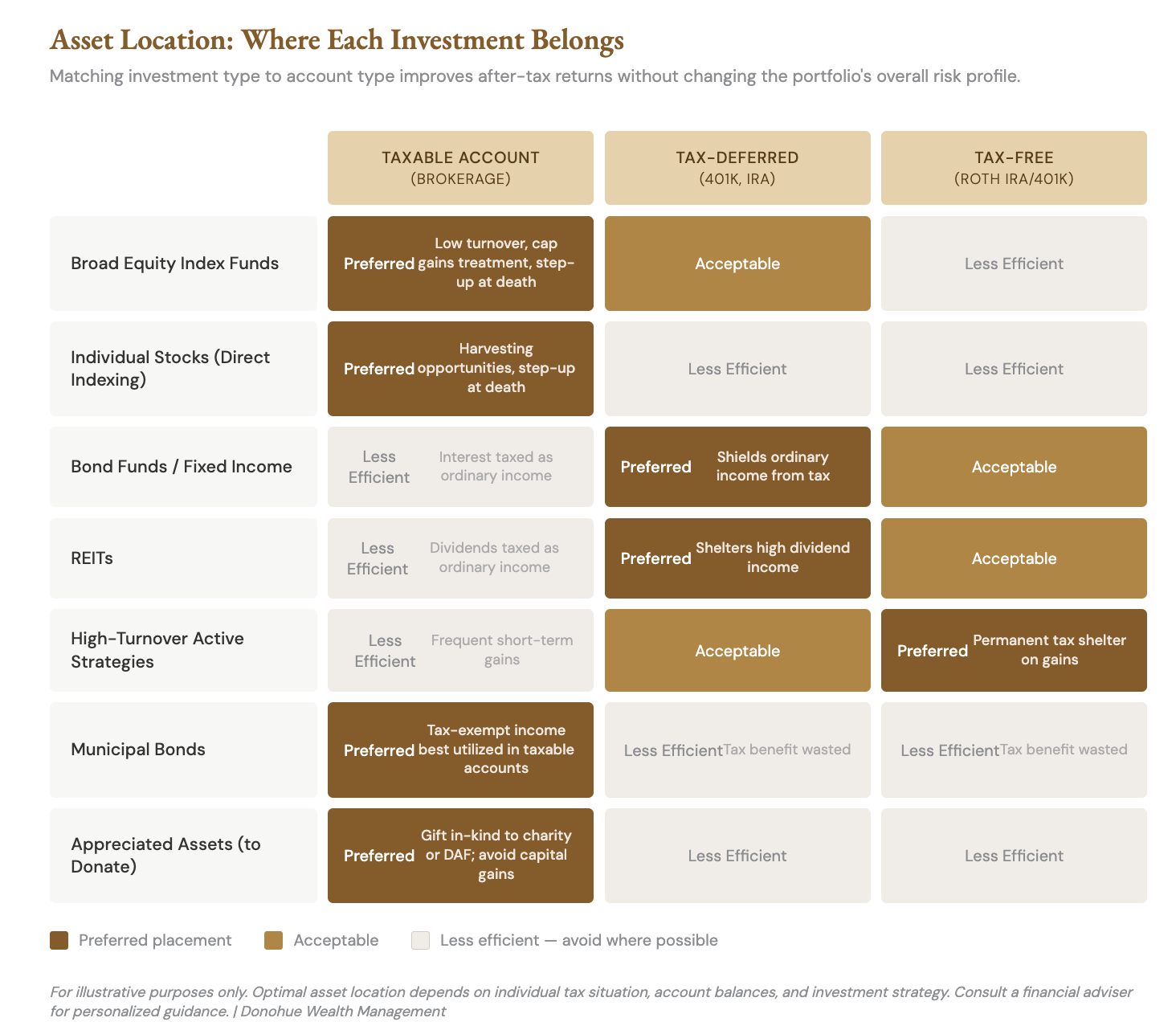
Once the right account structure is in place, the next question is which investments go where. This is called asset location, and it can improve after-tax returns without changing your overall investment strategy at all.
The principle is straightforward: assets that generate significant taxable income belong in tax-sheltered accounts, where that income does not create an annual tax drag. Assets that generate little taxable income, or that benefit from favorable capital gains treatment, are generally better suited to taxable accounts.
In practice, bond funds, REITs, and high-turnover strategies tend to belong inside tax-deferred or tax-free accounts. Broad equity index funds, individual stocks held for appreciation, and tax-managed strategies tend to work better in taxable accounts, where they can also benefit from tax loss harvesting.
Done consistently over time, proper asset location can add meaningful improvement to after-tax returns without any change to the risk profile of the portfolio.
Roth Conversions and Bracket Management
Most people think about tax brackets reactively: they earn income, that income falls into certain brackets, and they pay the corresponding rate. Tax planning flips that relationship. The goal is to actively manage which bracket you land in, and when.
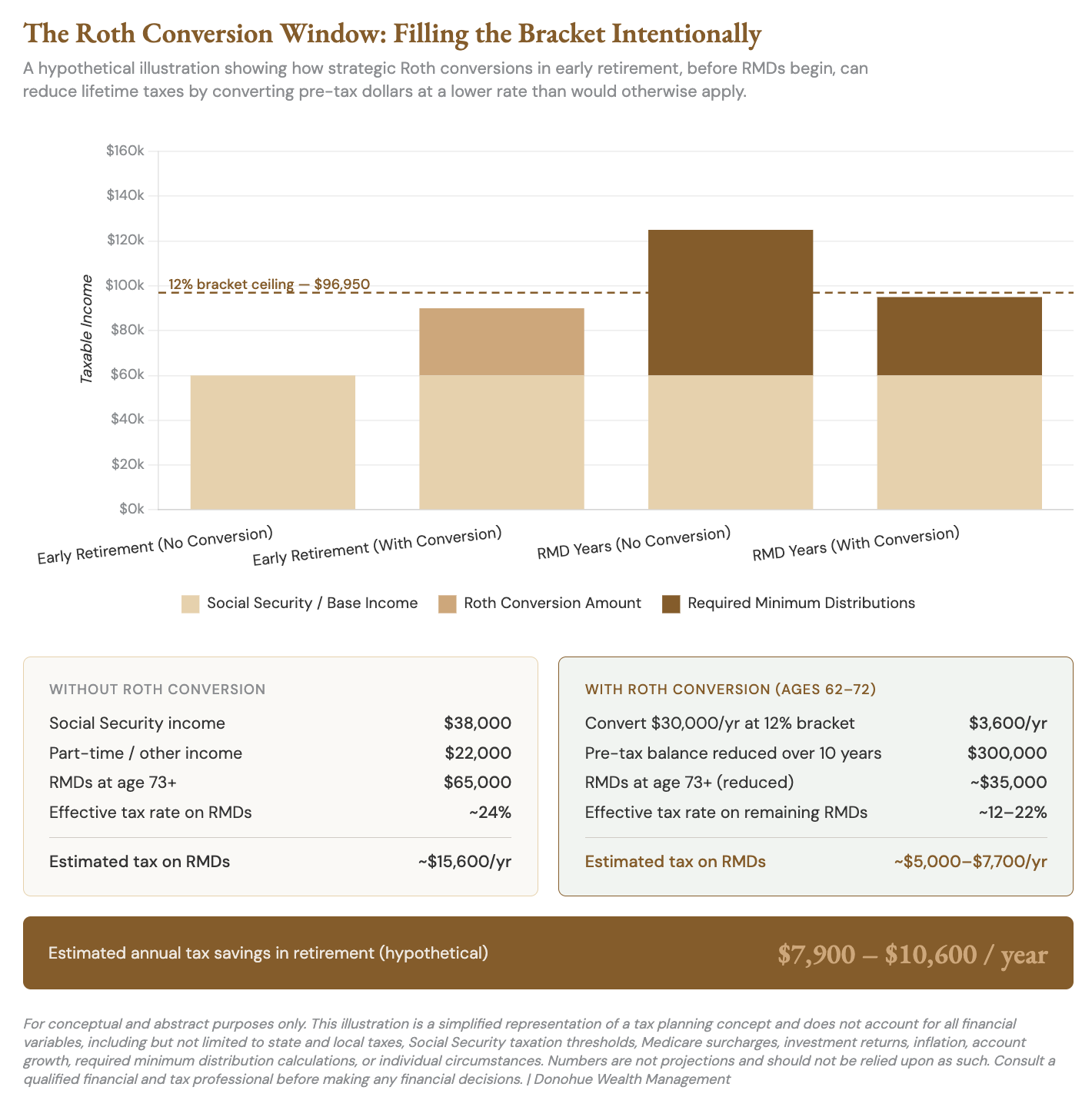
Roth conversions are one of the most powerful tools for doing this. A Roth conversion moves money from a traditional (pre-tax) retirement account into a Roth account, triggering ordinary income today in exchange for tax-free growth and distributions going forward. Done strategically, this can reduce your lifetime tax burden significantly.
The best windows for Roth conversions tend to be years when your taxable income is lower than usual: early retirement before Social Security begins, years with large deductions, or simply years where income is unusually low for other reasons. In those windows, you can convert pre-tax dollars at a lower rate than you would otherwise face later when required minimum distributions (RMDs) kick in.
Bracket management extends beyond conversions. On the income side, it means structuring deferred compensation, business income, or other variable income to avoid unnecessary jumps into higher brackets. On the investment side, it means harvesting capital gains in lower-income years, locking in favorable rates and resetting your cost basis while the tax cost is minimized.
Tax Loss Harvesting and Tax Alpha
Every portfolio experiences losses at some point. Most investors simply wait for positions to recover. Tax loss harvesting turns those temporary losses into a tangible benefit by selling the position to realize the loss, capturing the tax deduction, and immediately reinvesting in a similar (but not identical) security to maintain market exposure.
The result is a reduction in current year taxes, typically by offsetting capital gains elsewhere in the portfolio, without any meaningful change to the investment strategy. Done systematically throughout the year rather than as a year-end scramble, the compounding effect of those tax savings can be substantial.
For eligible clients, direct indexing takes this a step further. Rather than owning a fund that tracks an index, you own the individual securities that make up that index directly. This creates a far larger universe of harvesting opportunities, because individual stocks within an index are constantly diverging in performance, even when the index itself is flat or rising.
The improvement in after-tax returns generated through these strategies is sometimes referred to as tax alpha: return that is not earned by taking more investment risk, but by managing taxes more effectively. For clients in higher tax brackets, this can represent a meaningful and durable edge over time.
Morningstar research has estimated the annual value of tax-managed investing strategies at roughly 1.0 to 2.0 percentage points per year for taxable investors, though the actual benefit varies based on individual circumstances.
Capital Gains Management
Not all investment gains are taxed the same way. Assets held longer than one year qualify for long-term capital gains rates, which top out at 20% for most high earners. Assets held less than a year are taxed as ordinary income, which can reach 37% at the federal level. That difference matters enormously, and it is entirely within a client's control.
Thoughtful capital gains management means being deliberate about when gains are recognized, not just whether to sell. In years where ordinary income is lower, recognizing long-term capital gains at a reduced rate and resetting the cost basis can be a meaningful planning opportunity.
Beyond timing, capital gains management includes awareness of the 3.8% net investment income tax that applies to higher earners, the interaction between capital gains and the taxation of Social Security benefits, and the potential for IRMAA surcharges on Medicare premiums, which are triggered by income thresholds that include capital gains.
Distribution Planning in Retirement
For accumulation-phase investors, most tax planning focuses on reducing current income. In retirement, the focus shifts to something equally important: sequencing withdrawals intelligently across account types.
The order in which you draw from your accounts determines your tax liability each year in retirement, whether your Social Security benefits are taxed and at what rate, whether you trigger IRMAA surcharges on Medicare premiums, and how long your assets last.
A common default is to draw from taxable accounts first, tax-deferred accounts second, and Roth accounts last. But that default is not always optimal. In years where income is lower, drawing from tax-deferred accounts strategically, or converting to Roth, may reduce lifetime taxes significantly by drawing down the pre-tax balance before RMDs force distributions at higher rates.
Required minimum distributions add another layer. Starting at age 73, the IRS requires withdrawals from most tax-deferred accounts on a fixed schedule. For clients who have accumulated substantial pre-tax balances, those mandatory distributions can push income into higher brackets, increase Social Security taxation, and trigger Medicare surcharges. Planning for RMDs before they begin, through conversions, early withdrawals, or other strategies, is far more effective than reacting to them after the fact.
Charitable Strategies
For clients who give to charity, the mechanics of how they give matter as much as how much they give. The right strategy can amplify the impact of every dollar while meaningfully reducing the tax cost.
Donor Advised Funds (DAFs)
Allow a client to make a large, immediately deductible contribution in a high-income year, then recommend grants to specific charities over time. This lets you front-load the deduction when it is most valuable, without being forced to decide immediately where the money goes.
Qualified Charitable Distributions (QCDs)
Allow clients over age 70.5 to transfer up to $111,000 per year (as of 2026) directly from an IRA to a qualified charity. The distribution counts toward the RMD requirement but is excluded from taxable income entirely, making it more efficient than taking the distribution, paying tax on it, and then donating the after-tax amount.
Gifting Appreciated Assets
Donating appreciated assets directly to charity avoids the capital gains tax that would have been due on the sale, while still generating a deduction for the full fair market value. For clients with low-cost-basis stock or other appreciated holdings, this can be significantly more efficient than donating cash.
Charitable Remainder Trusts and Charitable Lead Trusts
For clients with more substantial charitable intent, charitable trusts offer a structured way to give that can generate income, reduce taxes, and ultimately benefit both the donor and the charity.
A Charitable Remainder Trust allows a client to transfer appreciated assets into an irrevocable trust, receive an immediate partial charitable deduction, and draw an income stream from the trust for a defined period or for life. At the end of the trust term, the remaining assets pass to the designated charity. The transfer avoids capital gains tax on the contributed assets and removes them from the taxable estate, while still providing the donor with ongoing income.
A Charitable Lead Trust works in the opposite direction: the charity receives income from the trust first, and the remaining assets pass to heirs at the end of the term. This structure is particularly useful for clients who want to transfer wealth to the next generation at a reduced gift or estate tax cost while supporting a charitable cause in the interim.
These structures involve meaningful complexity and require coordination with an estate attorney. But for the right client, they represent one of the more powerful intersections of charitable intent and tax efficiency available in financial planning.
Done intentionally, charitable planning serves two goals at once: amplifying the impact of generosity and reducing the tax cost of giving.
Legacy and Estate Tax Planning
The tax dimension of estate planning is one of the most consistently overlooked areas of financial planning, and one of the most impactful.
Step-Up in Basis
This provision resets the cost basis of appreciated assets to their fair market value at the time of the owner's death. Heirs who inherit those assets can sell them without paying capital gains tax on a lifetime of appreciation. Assets with the highest embedded gain are often best positioned to pass at death rather than be gifted during life, precisely because of the step-up.
Gifting Strategies During Life
Gifting allows clients to transfer wealth to family members while alive, reducing the taxable estate and potentially shifting future appreciation out of the estate. The annual gift tax exclusion ($19,000 per recipient in 2026) allows transfers with no gift tax consequence, and larger gifts can be made using the lifetime exemption.
Federal and State Estate Taxes
These become significant planning considerations as net worth grows. Massachusetts has its own estate tax with a lower exemption than the federal level, meaning planning for Massachusetts residents often requires earlier and more deliberate action than clients expect. Advanced trust structures, irrevocable life insurance trusts, and charitable strategies can each play a role in reducing exposure. Of course, rules are subject to change and individual circumstances may vary.
The Coordination Layer
No single tax strategy exists in isolation. The value of proactive tax planning comes not from any one technique, but from how those techniques work together across your income, your investments, your retirement accounts, and your estate.
That coordination requires visibility across the whole picture, which is exactly what a financial plan provides. A CPA sees the return. An estate attorney sees the documents. A financial adviser sees how everything connects, and where the decisions in one area create opportunities or risks in another.
The most impactful tax planning happens when those conversations are happening throughout the year, not just at filing time. When the Roth conversion is sized to fill the bracket without triggering the next IRMAA tier. When the charitable contribution is structured as a QCD to avoid increasing Medicare costs. When the appreciated stock is gifted rather than sold because the step-up at death is a better outcome for the estate.
These are the decisions that separate tax filing from tax planning. And they are the decisions we work to get right, year by year, alongside the broader financial plan.
Take the Next Step
Understanding how tax planning works is a starting point. Applying it to your specific situation, your accounts, your income, your timeline, and your goals, is where the real value is created.
If you'd like to explore what a more proactive approach to taxes could mean for your financial picture, we're happy to start that conversation.
Sources
Internal Revenue Service. "IRS Releases Tax Inflation Adjustments for Tax Year 2026." IRS Newsroom. 2025. irs.gov/newsroom
Morningstar. "Mind the Gap 2024." Morningstar Research. 2024. morningstar.com
Morningstar. "Tax-Managed Investing: The Value of Tax Alpha." 2025 Edition
Internal Revenue Service. "Qualified Charitable Distributions." IRS Publication 590-B. irs.gov/publications/p590b
Internal Revenue Service. "Estate and Gift Tax." irs.gov/businesses/small-businesses-self-employed/estate-and-gift-taxes
Massachusetts Department of Revenue. "Estate Tax." mass.gov/estate-tax
DALBAR, Inc. "Quantitative Analysis of Investor Behavior." 2026 Edition
Disclosures
This article is provided by McAdam LLC ("McAdam" or the "Firm") for informational purposes only. Investing involves the risk of loss, and investors should be prepared to bear potential losses. Past performance may not be indicative of future results and may have been impacted by events and economic conditions that will not prevail in the future. No portion of this article is to be construed as a solicitation to buy or sell a security or the provision of personalized investment, tax, or legal advice. Certain information contained in this report is derived from sources that McAdam believes to be reliable; however, the Firm does not guarantee the accuracy or timeliness of such information and assumes no liability for any resulting damages.
Any references made regarding the taxable nature of your investments should not be construed as tax advice. McAdam LLC is not a tax advisory firm; therefore, any tax decisions or assumptions should be made/verified with your tax professional.
Donohue Wealth Management is a DBA of McAdam LLC, an SEC registered investment adviser. Registration does not imply a certain level of skill or training. Chart data is for illustrative purposes only and does not represent the results of any specific investment strategy or client account.